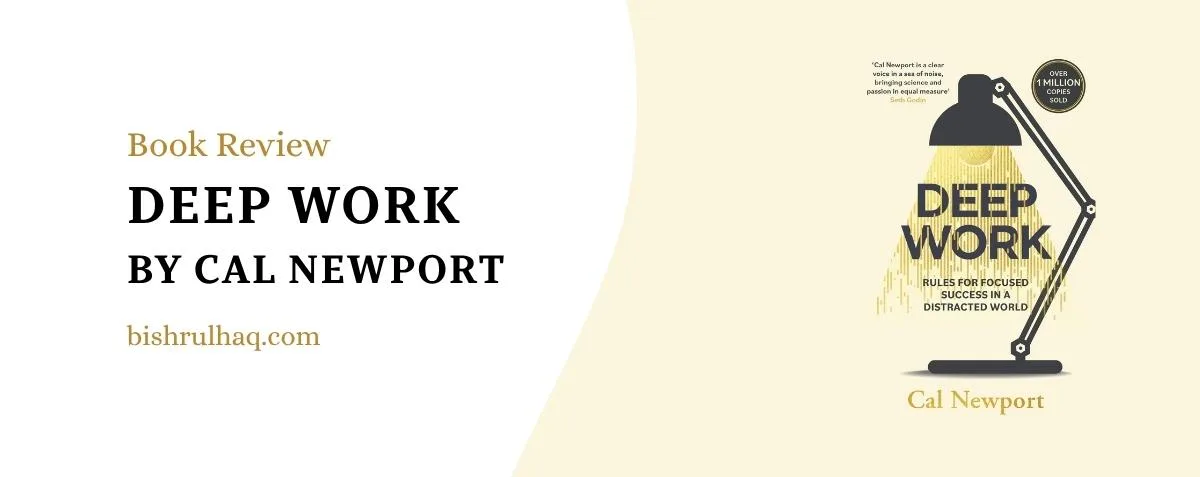
I came to Deep Work after losing an entire afternoon to small tabs. Emails, a text thread, three articles I half-read, a YouTube rabbit hole that started with a Car Documentary video and somehow ended on a Cooking video. At the end of five hours I had finished exactly nothing of importance, and I was still tired. That is the state Cal Newport wrote this book for, and I suspect it is the state most people reading it were already in when they picked it up.
The central argument
Newport's claim is simple and, by the end of the book, hard to argue with. The ability to focus without distraction on a cognitively demanding task is a skill that is becoming rarer in the modern economy, and at the same time is becoming more valuable. That gap, between how rare the skill is and how much it pays, is where a lot of careers are being quietly won and lost. Newport calls this skill deep work, and the book is an extended argument that you should get much better at it if you want the rest of your professional life to go well.
He contrasts it with what he calls shallow work. Email. Meetings. Quick tasks. Status-update threads. Everything you can do while half-distracted. Shallow work feels productive. It rarely is. What is quietly terrifying about the book is how much of the modern workday, for most of us, is made almost entirely of shallow work, and how little of it actually moves anything forward.
Why the book hit harder than I expected
I thought I already knew this. I had read enough productivity content to nod at the idea of focus. What Newport does that most writers in this genre do not is back it up with specific examples and specific mechanisms. Carl Jung built a stone tower to write in. Bill Gates famously took weeks off for "think weeks" with no phone, no meetings, and a stack of books and papers. Newport himself schedules every hour of his day in advance and keeps a hard cap on how much shallow work he allows in a week.
The point is not that you should copy any of these people. The point is that almost nobody who produces remarkable work leaves their attention to chance. That is a simple observation, and it lands harder when you read a hundred and fifty pages of specific examples of it than when you read it as a single sentence on a productivity blog.
The four rules
The book is structured around four rules that are worth listing plainly.
- Work deeply. Schedule real, protected blocks of focused time and treat them like meetings with yourself.
- Embrace boredom. Train your brain to tolerate the absence of stimulation, because constantly feeding it distractions wrecks its ability to concentrate when you actually need it to.
- Quit social media. Or at least audit your tools. Most of them are designed to fracture attention for profit.
- Drain the shallows. Ruthlessly reduce the time you spend on low-value busywork, and defend that reduction against colleagues who will try to undo it for you.
Rule two is the one that changed something for me. I used to reach for my phone the second there was a lull. Waiting for a kettle. Standing in a queue. A pause between meetings. Newport makes the case that this habit, more than anything else, is what has atrophied your ability to sit with a hard problem. If you cannot handle three minutes of standing still without reaching for a screen, you are going to struggle to handle three hours of a difficult writing task. The claim is uncomfortable because it is obviously true.
What Newport gets right
The book is respectful of your time. Short chapters. Clear examples. No long personal narratives about the author's heroism. Newport trusts you to take his framework and adapt it to your life, rather than selling you a proprietary system with a brand name and a monthly subscription.
He is also honest about the cost of deep work. It is not fun. Most people experience it as mildly unpleasant, at least at the start, because focus is effortful and the brain genuinely prefers the lighter hit of task-switching. Most productivity books try to sell you a painless version of focus. Newport tells you it will be uncomfortable, and then shows you why it is worth the discomfort anyway. Honesty about cost is rare in this genre, and I trust the book more because of it.
Where the advice struggles
Newport spent most of his career as an academic, which means his default environment supports long, uninterrupted blocks of thinking in a way that most corporate jobs simply do not. If your calendar has five meetings a day and your manager expects a reply to Slack within twenty minutes, protecting two hours of deep work will require a political negotiation that the book does not really help you with. He nods at this briefly in the rules. He does not go deep into it.
The chapter on quitting social media is also less practical than it sounds. Many readers cannot simply quit the platforms their work depends on. I would have appreciated a more careful middle path here, one that acknowledges that some of us are stuck with these tools for reasons outside our immediate control and still want to protect what attention we have left.
Who should read this
- Knowledge workers who feel like they are busy every day and producing nothing.
- Students who want to learn how to study in a world where every five minutes brings a new ping.
- Writers, researchers, programmers, and anyone else whose output depends on being able to hold a problem in their head for long stretches.
- Anyone who has noticed their attention span shrinking over the last few years and is quietly alarmed by it.
This is one of the few productivity books I have re-read, and the second read was better than the first. The first pass teaches you the vocabulary. The second pass teaches you how much of your life has actually been shallow, and that is a harder lesson to sit with, and a more useful one.






Comments
0No comments yet. Be the first to share your thoughts.