

I have a complicated relationship with this book. Can't Hurt Me is the loudest book on my shelf. It shouts at you for 350 pages and then asks if you want a second helping. I finished it in four sittings, mostly because I could not put it down, and I closed it feeling both energised and slightly bruised. That is the Goggins effect, and your mileage will vary based on what your nervous system can take.
What this review covers
- Why this book is louder than anything else on my shelf, and whether that is good
- The 40 Percent Rule and the accountability mirror, with my own small experiment
- Where the framing is hard to defend, and who should not pick it up
- What stayed with me a year later, and what did not
Danger
Read this part before deciding to read the book
Goggins is not for everybody. The voice is unrelenting and the book has very little patience for context. If you are dealing with chronic illness, depression, an injury, or any of the other reasons people live below their potential through no moral failure of their own, his framing can feel like blame. There is a softer version of the central idea that is genuinely useful. The harder version, taken straight, can hurt more than it helps.
What the book is
It is a memoir, written with the help of a co-writer, that walks through David Goggins' childhood, his time in the Navy SEALs, his ultramarathon career, and the relentless inner script he uses to push past every limit his mind invents. Each chapter ends with a "challenge" the reader is invited to do. Some of these are reasonable. Some are not. There is a part where he tells you to look in the mirror and tell yourself the truth about who you are. There is another where he basically asks you to run further than your training has prepared you for. I did one of these. I did not do all of them.
What worked on me
Goggins' core argument is that most of us live at about forty percent of what we are actually capable of. He calls it the 40 Percent Rule. When your mind tells you it is done, your body has another sixty percent in reserve. This is not new science, and Goggins is not claiming it is, but the way he hammers on it for hundreds of pages does something useful. It reframes "I can't" as "I have hit my comfortable upper bound."
The most important conversations you'll ever have are the ones you have with yourself.
I read that sentence at a point when I was telling myself I was too tired to finish a piece of work I had promised on Friday. I was lying. I was not too tired. I was annoyed and slightly bored. Goggins did not let me hide from that. The work went out on Saturday morning instead of the following week. That counts for something.
The accountability mirror
The exercise that did the most for me was the "accountability mirror." Goggins walks you through a period in his life where he was overweight, depressed, and going nowhere. Every morning he wrote a list of things he was actually bad at, stuck them to his bathroom mirror, and refused to let himself off the hook. No motivational quotes. No vague affirmations. Specific, ugly truths.
I tried a much smaller version of this for a week. Three sticky notes. "You skip the gym when work gets hard." "You have not called your father in two months." "You half-listen on Friday afternoons because you are already mentally checked out." It was not pleasant, and three of the seven mornings I did not look at the mirror at all. By the end of the week I had exercised four times, called my father, and got through one Friday with my attention actually on. Small, but real. The book is at its best when it is making you do something you have been avoiding.
The book in balance
✓ What works
- Forces you to look at the version of tired or bored that is actually avoidance
- The accountability mirror is a small habit that genuinely shifted my week
- Each chapter ends with a concrete prompt, not a vague affirmation
- Honest about his own past in ways that earn the harder claims
✕ Where it falls short
- The voice has very little patience for circumstance you did not choose
- "Stop being a victim" appears more than once and it does not always land kindly
- The marathon stories blur in the second half and the grip loosens
- Frames suffering as the only honest path, which is not the whole truth
Things I underlined
- "You're not raising the bar. You're raising the floor." Most people compete on peak effort. The thing that compounds is your minimum acceptable behaviour on a bad day.
- "Suffering is the truest test of life." I would soften this. Suffering, when it is voluntary and pointed at something you care about, builds you. Suffering imposed on you randomly does not always.
- "Callus your mind." His point is that mental toughness is a muscle, and you build it by deliberately doing hard things you do not need to do.
Who should read it
- Anyone who has been quietly coasting on a story about being tired.
- People who keep finding reasons to delay something hard they know they should do.
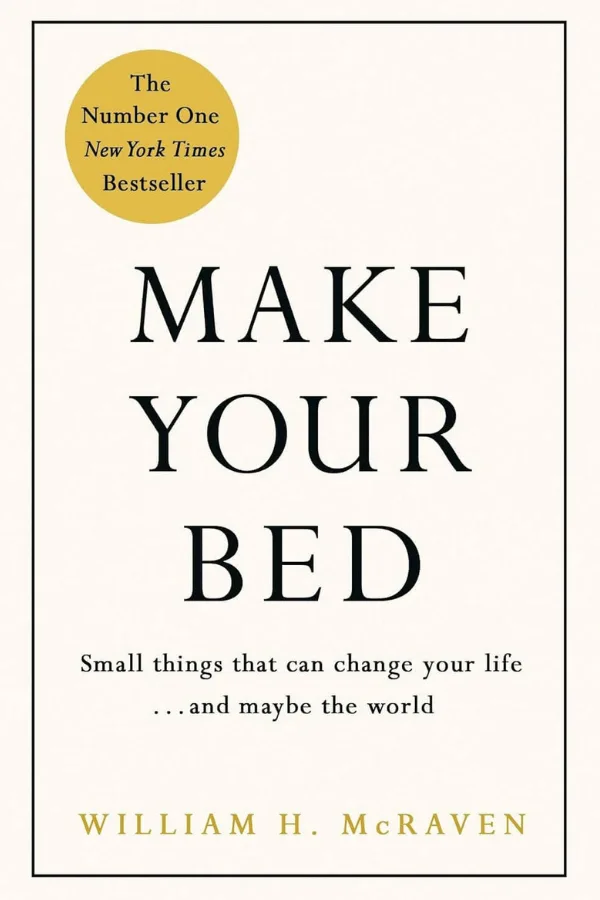
- Readers who liked Make Your Bed by Admiral McRaven and want a heavier, less polished cousin.
Final thought
I gave it four stars instead of five because the second half lost a little of its grip on me. After a while the marathon stories blur, and I stopped underlining things in the last seventy pages. But I would still rather read a book like this, that goes too hard and risks being too much, than a polite book that gives me permission to do nothing.
I will not reread it. I do not need to. The first read changed something in how I talk to myself when I am tired, and that change has stayed. That is the whole job of a book like this. Goggins did the job. I will let him close the book and stop yelling at me.



Comments
0No comments yet. Be the first to share your thoughts.