
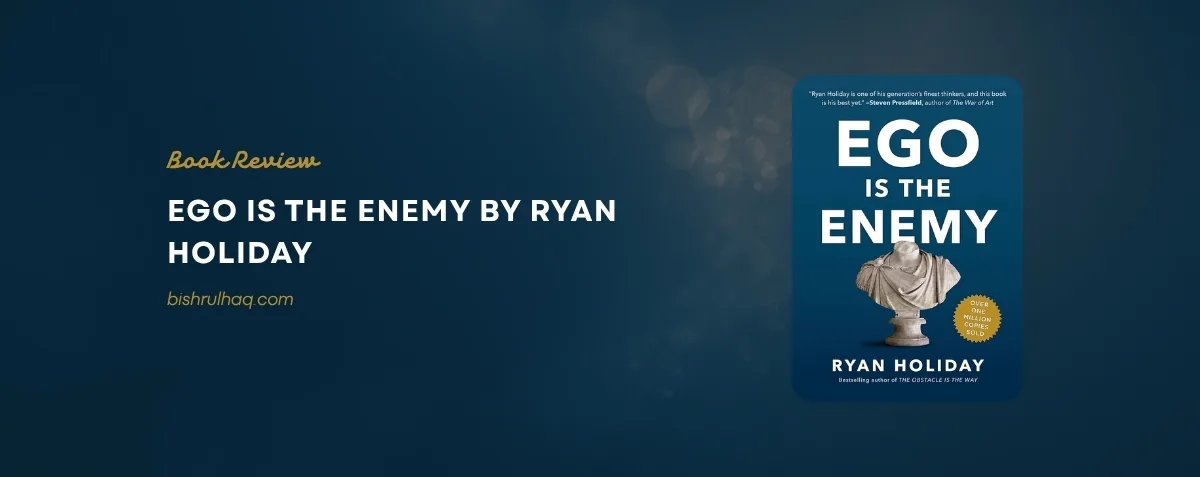
Ryan Holiday's warning about ego is useful because it does not wait until someone becomes famous or powerful. The book treats ego as a daily problem, something that can show up in a meeting, a message, a creative project, or the small refusal to admit you were wrong.
I liked that approach. Ego is easy to condemn when it is loud in someone else. It is harder to notice when it sounds like ambition, self-protection, taste, or the private need to be seen as exceptional.
Ego before, during, and after success
Holiday is at his best when he treats ego as a practical obstacle rather than a moral failure. Ego makes you stop learning. It makes feedback feel like an attack. It makes success more dangerous than failure because it convinces you the story is about you.
The structure around aspiration, success, and failure is smart. Ego does not disappear when your circumstances change. It adapts. Before success, it makes you talk more than you work. During success, it makes you stop learning. After failure, it makes you defensive when you most need honesty.
Holiday's Stoic influence is clear, but the book stays practical. The main message is not to hate yourself or shrink your ambition. It is to stop letting the story of yourself become more important than the work itself.
Ego checks from the book
- The book is organised around aspiration, success, and failure.
- Its strongest point is that ego changes shape at each stage.
- The practical lesson is to stay a student longer than pride wants you to.
The parts that felt most useful
The best idea is staying a student. That sounds humble in a harmless way, but it is actually demanding. A student asks questions, accepts correction, watches better people carefully, and does not need to be treated as the finished product.
I also liked the book's attention to success as a danger. Failure has obvious pain. Success is more subtle. It can make your old hunger look like wisdom and your luck look like proof that you deserve special rules.
The book is especially sharp for creative work. Ego wants applause early. It wants identity before craft. It wants the appearance of mastery before the boring repetition that mastery requires. That is a problem for anyone building anything.
Ambition without theatre
The reason this book matters is that ambition can be healthy and still become theatrical. You can start wanting to do good work, then slowly become more invested in being seen as the kind of person who does good work. Ego lives in that gap.
Holiday's warning is useful because it protects the work from the image. The work needs patience, correction, repetition, and quiet standards. The image wants applause, speed, comparison, and a story where every setback proves you are misunderstood.
I thought a lot about the difference between confidence and ego. Confidence can listen. Ego performs certainty because listening feels like losing status. Confidence can ask for help. Ego would rather fail privately than learn publicly.
The book also has a good message for failure. When things go wrong, ego wants a clean villain. It wants to blame the market, the audience, the boss, the timing, the team, the platform, or the unfairness of the world. Some of that may be real, but ego uses it to avoid the part that belongs to you.
A better ambition is quieter. It still wants excellence, but it does not need every room to confirm its importance. That is the version of ambition the book points toward, and it is the version that seems more likely to survive both praise and disappointment.
The question after praise
The moment to remember this book is after praise, not only after criticism. Praise is pleasant, but it can quietly change your appetite. You may start wanting the proof of being good more than the practice that made you good.
A useful question is: what would I do next if nobody needed to know I did it? That question cuts through a lot of ego. It points back to the work, the craft, the responsibility, and the private standards that applause can easily blur.
Who should read it before they need it
This is useful for people with ambition, which is almost everyone if we are honest. Founders, writers, students, managers, athletes, creators, and professionals can all find themselves in these pages.
I would read it before a big promotion, a public win, or a new project. It is easier to keep ego small before it starts feeding on evidence.
What works and what does not
✓ What works
- Short, direct, and easy to revisit
- Good historical examples that make the point memorable
- Useful for creative work, leadership, and ambition
✕ Where it falls short
- Some examples feel selected to fit the lesson too neatly
- The style can become aphoristic
- More diagnostic than deeply therapeutic
Where the book can feel too neat
The book sometimes uses historical examples a little too cleanly. Real lives are complicated, and examples can be shaped to fit a lesson. That does not make the lesson false, but it does mean the reader should not treat every story as final proof.
The style can also become aphoristic. Short lines are memorable, but they can make deep problems look simpler than they are. Ego is not defeated by underlining a sentence. It has to be met repeatedly.
How to turn it into behaviour
I would practice the book by asking one question after any win: what did luck, timing, help, or previous work contribute here? That question does not reduce achievement. It keeps achievement accurate.
I would also keep a beginner task nearby. Learn something where you are not impressive yet. Let yourself be corrected. Do work nobody applauds. Ego has less oxygen when the work is bigger than the image.
The warning I am keeping
This is a useful book to read when things are going well. Failure humbles most people eventually. Success is trickier. It needs deliberate humility before it starts quietly bending your character.
The book's best warning is that ego does not always look ugly. Sometimes it looks like confidence. That is why it needs watching.


Comments
0No comments yet. Be the first to share your thoughts.