
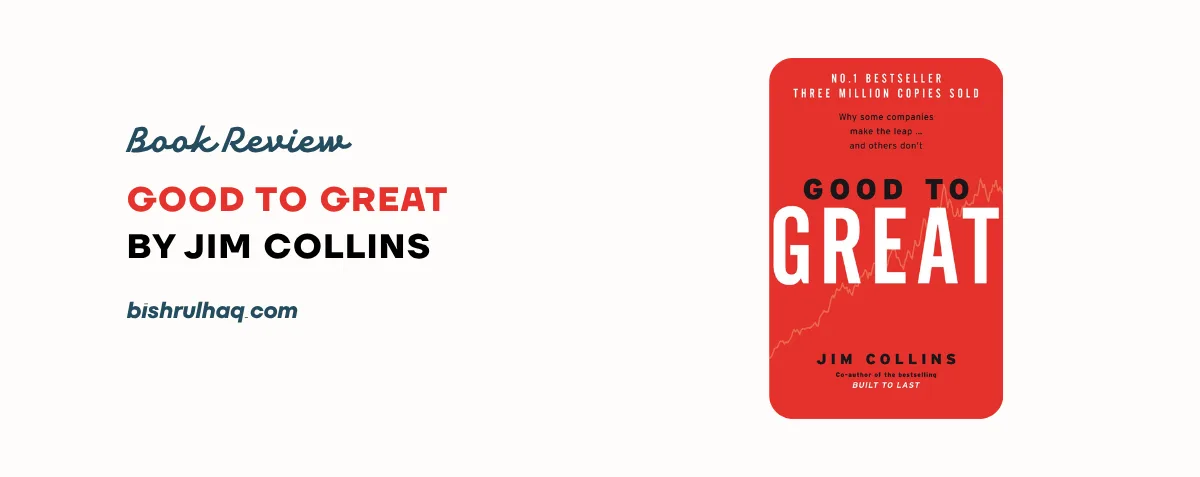
Jim Collins's Good to Great is the book that, for a decade, every corporate leadership training programme seemed to be pulling its slides from. I put off reading it until this year because I assumed it would be dated, heavy on case studies about companies nobody remembers, and padded with the usual MBA vocabulary. I was wrong on two of those three counts, and I am glad I finally picked it up.
The study that drives the book
Collins and his research team spent five years studying publicly traded American companies that, at some point in their history, transitioned from merely good performance to sustained greatness. They defined the transition in specific numerical terms, looked for patterns in how these companies differed from comparable companies that did not make the leap, and controlled for factors like industry and luck. The book is the summary of what they found.
The research methodology is genuinely impressive. The sample is small, the criteria are strict, and the comparisons are careful. A lot of business books in this era threw together anecdotes about whichever companies were in the news and called it a study. Collins actually built a study, and the book benefits enormously from the fact that it has something real underneath it rather than just a few recycled anecdotes about the famous founder of the moment.
Level 5 leadership
The idea most people remember from the book is the concept of Level 5 leadership. Collins identified a specific leadership style that showed up at every single one of the great companies during their transition period. These leaders were quiet, humble, sometimes awkward in public, and almost always credited their teams and their circumstances rather than themselves. They were relentless about results and modest about their own contributions.
This is not the charismatic visionary your Twitter feed pushes at you. It is closer to the opposite. The research is pretty clear that the flashy, ego-driven CEO profile is correlated with short-term wins and long-term blow-ups, while the quiet, mission-first leader is correlated with durable greatness. That is not a popular finding, but it is probably the most important one in the book, and it has aged better than most of the other ideas in the management literature of its era.
The Hedgehog Concept
The second durable idea is the Hedgehog Concept, Collins's term for the intersection of three questions that every great company had answered clearly.
- What can you be the best in the world at?
- What drives your economic engine? That is, where does the money actually come from?
- What are you deeply passionate about?
Great companies do only the work that sits in the overlap of all three. Merely good companies chase opportunities that only satisfy one or two. I have used this framework on my own career and on a couple of side projects, and it has killed some ideas that I was otherwise tempted to keep pursuing. The questions are simple. Living by the answers is not, because living by them means saying no to most of the attractive opportunities that come across your desk.
The flywheel
Collins uses a metaphor of a heavy flywheel to describe how great companies grow. You push, and nothing visible happens. You push again, and still nothing visible happens. You keep pushing. At some point the flywheel starts to spin faster, and eventually it accumulates enough momentum that a small push produces an enormous result. The point is that there is no single decisive moment. There is only the compounding of many unglamorous pushes, and the real skill is staying the course long enough for the flywheel to do its work.
Anyone who has tried to build anything over a long timeframe will recognise this picture. The early phase, where nothing seems to be happening, is where almost everyone quits. The people who stay usually look foolish for a while before they start to look wise. The flywheel metaphor is not new, but Collins's version of it is one of the cleanest in print, and it is the image I reach for most often when I am explaining to someone why their own project feels like it is stuck.
First who, then what
One chapter that surprised me was "First Who, Then What." Collins argues, against a lot of conventional business advice, that great companies usually figured out who should be on the team before they figured out what the strategy should be. They got the right people on the bus, and then decided where the bus was going, rather than planning the route first and then hoping the right people would show up later.
This is not the advice that most leadership books give, and I am not sure it is universally correct. Plenty of successful companies have been built around a specific product insight with a team assembled afterward. But as a principle for established companies trying to transition from good to great, Collins's argument is strong. The strategies that great companies executed were usually changes of direction that required a team already capable of changing direction, and that capability was a function of who was on the team rather than what the current plan said.
Where the book has aged
Some of the companies Collins held up as examples of sustained greatness went on to struggle badly in the decade after the book was published. Circuit City is the obvious one. Fannie Mae is another. This is not entirely a failure of Collins's research, because the book was honest about studying a specific historical period. But it does mean you should read the case studies as snapshots of a moment rather than as forever-valid recipes for what any specific company will do next.
The frameworks, though, hold up. Level 5 leadership is still the right target. The Hedgehog Concept is still a good filter for strategy. The flywheel is still how durable businesses actually grow. The specific companies have churned. The ideas have not, and that is usually the test of whether a business book is worth reading a decade after it came out.
The confronting-brutal-facts chapter
One of my favourite chapters is called "Confront the Brutal Facts (Yet Never Lose Faith)." Collins argues that great companies maintain an unshakable belief that they will ultimately prevail, while at the same time facing the ugliest parts of their current reality head-on. He calls this the Stockdale Paradox, after the Vietnam prisoner of war who observed that the optimists in the camp were the ones who died first. The optimists set unrealistic deadlines for their rescue, were repeatedly disappointed, and eventually gave up. The survivors were the ones who held faith in eventual survival while being completely honest about how bad the current situation was.
I think about this chapter a lot, and not just in a business context. It is good advice for anyone trying to do something hard over a long period of time.
Who should read this
- Founders, managers, and operators who want a serious book about what separates lasting companies from flashy ones.
- Anyone sceptical of the modern celebrity-CEO story who wants data on the alternative.
- Readers who enjoy business history as a way of understanding strategy, because half the book is essentially a set of case studies.
- Anyone working on a project that has not yet gained traction, because the flywheel chapter will help you stay with it through the unrewarding middle.
This is still the best book I have read on sustained organisational performance. The examples are dated. The thinking is not, and I suspect it will still be worth reading ten years from now, when the companies in the case studies have all become footnotes and the ideas are still doing useful work.





Comments
0No comments yet. Be the first to share your thoughts.