
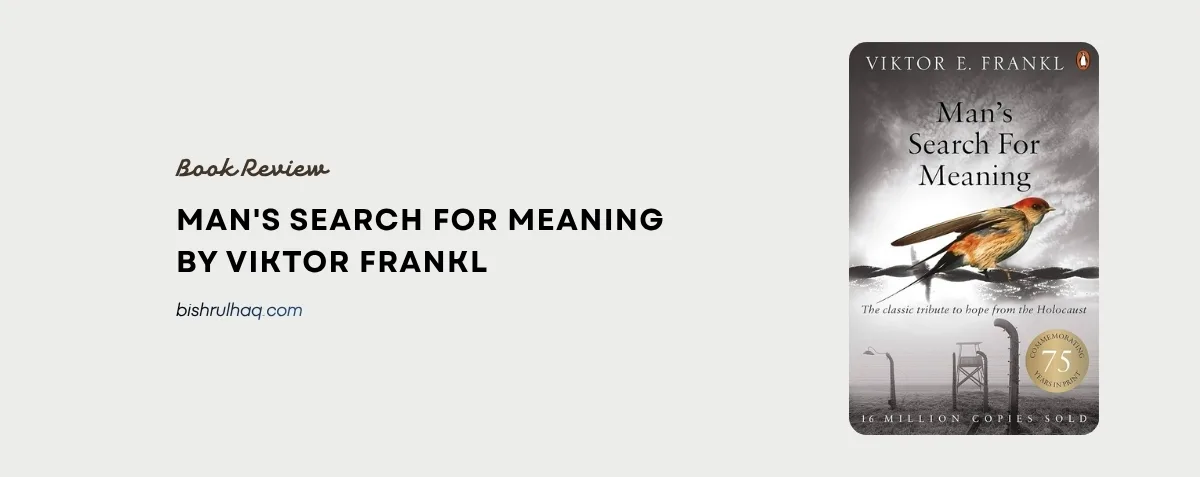
I almost did not read this book. I had owned a copy for years, and it kept getting passed over for something more current. Part of me suspected it would be too heavy. Part of me knew it would be useful, and was avoiding being useful at, which, looking back, was not a flattering self-pattern. I finally opened it during a quiet week between holidays, mostly because I had run out of excuses to delay. I was wrong about the weight. The book is sharper and lighter than its reputation. I wish I had read it ten years earlier.
What this review covers
- Why I avoided this book for years, and why that was a mistake
- The two halves: the camp memoir and the introduction to logotherapy
- Frankl's three sources of meaning, and the one most modern self-help skips
- The caveat I would say out loud before handing this to a friend in a hard season
What the book actually is
It is split into two parts that almost feel like two different books. The first part is a memoir. Viktor Frankl was a Viennese psychiatrist who survived three years across four concentration camps, including Auschwitz. He writes about that experience without sentimentality, without sensation, and without easy lessons. The second part is a short introduction to logotherapy, the school of psychotherapy he founded, which is built on the simple but unfashionable claim that human beings are primarily driven by a search for meaning, not pleasure or power.
The two halves work together. The memoir is the evidence. The theory is the conclusion. Frankl is not asking you to take his framework on faith. He is showing you, in awful detail, the conditions under which it was forged.
The first half is harder than I expected
I had read other accounts of the camps before. This one is different in a way I struggled to name at first. Frankl writes as a clinician and as a survivor, and he refuses both the temptation to dramatise and the temptation to flatten. He describes the daily routines, the small choices that filled the long days, and the patterns he noticed in who survived and who did not. It is brutal reading. I had to put it down twice in the first sitting.
What stays with me is not the worst of it. It is the smaller observation, repeated quietly across the chapters, that prisoners who could hold on to a future, a task they were going to finish, a person they were going to see again, a piece of writing they had not yet completed, were more likely to survive than those who could not. Frankl is careful not to romanticise this. He saw plenty of people with futures die anyway. But he noticed the pattern, and he took it seriously enough to build the rest of his life on it.
He who has a why to live for can bear with almost any how.
Frankl quotes Nietzsche on this point and then spends the rest of the book defending the claim. Most days, the modern version of "any how" is small. Traffic. A boring meeting. A bad performance review. A bill arriving when you cannot afford it. And yet the same principle holds. If you do not have a clear why, the smallest hows can knock you sideways for hours.
The second half quietly does the work
Logotherapy, in Frankl's hands, is a careful and humane idea. He proposes that meaning can be found in three places: in something you create, in someone you love, and in the stance you take toward unavoidable suffering. The third one is the move most modern self-help books skip. Frankl is direct: there will be parts of your life you cannot fix and cannot escape. The freedom you have left, in those moments, is the choice of attitude.
Between stimulus and response there is a space. In that space is our power to choose our response. In our response lies our growth and our freedom.
That sentence has been quoted into the ground, often without crediting Frankl, and almost always without the surrounding context. Read it inside the camp memoir and it is not a poster. It is a survival skill that was tested under conditions most of us cannot imagine.
Where it landed for me
I read this during a year where my own life felt unusually small. Nothing dramatic. Just a long, low season. I was getting through days without seeing them. Frankl's frame, that meaning is found in tasks that need you, people who need you, and stances toward the things you cannot change, was a quiet rearrangement of the furniture in my head. I started keeping a small notebook by the bed. One line a night. What was the most meaningful thing about today, however small. The list was almost never about achievement. It was usually a face, a sentence somebody said, a moment with my mother, a piece of music I had not heard in a long time. Frankl was right.
I also went back to a long-stalled writing project the same week. I cannot pretend that is a coincidence.
What I underlined
- "In some way, suffering ceases to be suffering at the moment it finds a meaning."
- "When we are no longer able to change a situation, we are challenged to change ourselves."
- "Don't aim at success. The more you aim at it and make it a target, the more you are going to miss it."
- "Ultimately, man should not ask what the meaning of his life is, but rather must recognize that it is he who is asked."
The last one is the one I keep returning to. The frame is reversed from what most self-help asks of you. Life is the questioner. You are the answer. You answer not in sentences but in the way you actually live. That is a quiet, demanding standard, and it is the one this book leaves you with.
Danger
A caveat worth saying out loud
This book is short and very direct, and it has been recommended for everything from depression to mid-career drift. It is not a substitute for actual help if you are seriously struggling. Frankl himself would be the first to say that. The book is one of the most useful things I have read about how to find meaning under pressure. It is not a treatment plan. If you are in a genuinely dark stretch, please read it alongside the support you actually need, not instead of it.
Who should read it
- Anyone in a long, low season who can no longer say what their days are for.
- Readers who liked 12 Rules for Life for its insistence that you have a duty to take yourself seriously.
- People who have heard the Frankl quotes secondhand and want the source, in context, to see how careful and humane the original is.
I would also hand it to anyone in their thirties or forties who has finished most of the obvious goals they set in their twenties, looked up, and felt nothing. The book gives a usable, unfashionable answer to the silence that follows.
Final thought
I gave it five stars without hesitating, and I do not give five stars often. The book is short, it is honest, and it does the rare thing of making a serious philosophical argument without losing its gentleness. I came away feeling lighter, not heavier, even though every page is built on real horror. That is the strange gift of the book. Frankl saw the worst of what people can do to each other and walked away convinced that meaning is still available, every day, in small choices. Reading him, I believed it too.
I keep my copy near the books I plan to reread. It is short enough that you can finish it in a weekend, and important enough that you probably will, more than once.

Comments
0No comments yet. Be the first to share your thoughts.