
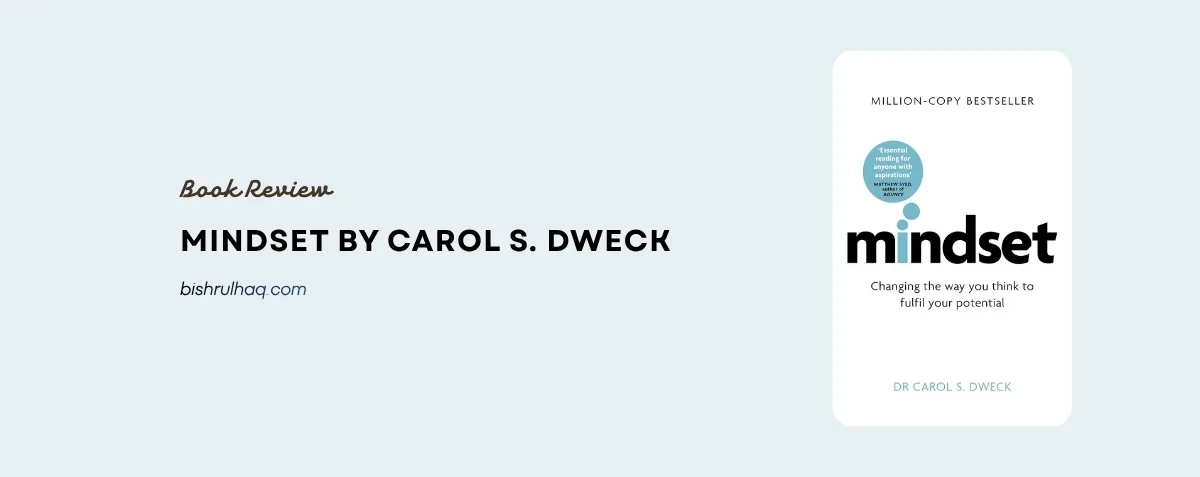
I avoided this book for years because I thought I already knew what was in it. Growth mindset versus fixed mindset. Effort matters. You can hear the summary in any TED talk. What I underestimated was how different it is to read the actual book. Carol Dweck has spent decades doing the research, and the patience of that work shows up on the page. By chapter three I had recognised myself in the wrong category several times, and that is more useful than any summary can be.
What this review covers
- Why the summary version of this book is misleading, and the actual book is not
- The single asymmetry I noticed in myself that the book gave me language for
- The leadership chapter that earns the price of the book on its own
- Where the popular version of "growth mindset" has gotten ahead of the original research
The two mindsets, in one paragraph
Dweck's research is built on a simple split. People with a fixed mindset believe their abilities are mostly innate. You either have the talent or you do not. Effort, in this view, is what people without talent have to do. People with a growth mindset believe abilities are mostly developed. Effort is the path. Failure is data. Talent is a starting point, not a verdict. Most of us, Dweck argues, are not in one camp permanently. We carry both mindsets and switch between them depending on the domain.
That last point is the one I missed in summaries. I have a growth mindset about my main line of work. I can read, fail, try again, and stay calm doing it. I have a fixed mindset about writing. When a draft does not land, my first reaction is "I am not actually a writer," not "this draft needs another pass." The book gave me language for that asymmetry.
Where it landed for me
Becoming is better than being.
Three words, and they reframe a lot of how we hold our titles. Senior. Lead. Director. We treat these as nouns, fixed states. Dweck would say the more useful frame is the verb. Becoming. You are always in the middle of becoming something, whether or not your title has changed.
The chapter on praise was also harder than I expected. Dweck has done years of experiments showing that telling kids "you're so smart" actively damages their relationship with effort, while telling them "you worked hard" makes them more resilient. I started auditing how I gave compliments after this chapter, both at work and at home. I had been praising the result, not the process. Subtle, but apparently consequential.
The leadership chapter is worth the price of the book
The middle of the book covers business and leadership, and this is where I got the most practical value. Dweck profiles leaders with both mindsets and shows what happens to their organisations. The fixed-mindset CEOs surround themselves with people who validate them, punish failure publicly, and create cultures where nobody admits a mistake until it is on fire. The growth-mindset leaders treat failure as a teacher, hire for trajectory rather than pedigree, and ask "what did we learn" before "whose fault."
I have worked under both kinds. The book gave me a clean diagnostic for which one a culture actually has, regardless of what its values poster says. A simple test: in your last serious post-mortem, did anyone get blamed by name in the document? If yes, you might be in a fixed-mindset shop dressed up as a growth-mindset one.
What I took into my week
- I changed how I phrase feedback at work. Less "this is wrong," more "have you tried thinking about it as X." Same content, different mindset signal.
- I caught myself, in two separate situations, refusing to try something because I was worried about looking stupid. Dweck calls this "protecting the genius label." I tried the things anyway. One went well. One did not. I survived both.
- I started saying "I am not good at this yet" out loud. The "yet" is small and feels silly the first time. It also makes a real difference in whether you go back the next day.
The book in balance
✓ What works
- Decades of research distilled with the patience of an academic, not a marketer
- The leadership chapter is the cleanest diagnostic for organisational culture I have read
- Gives you language ("yet", "the genius label") that quietly changes self-talk
- Goes into specifics on praise, parenting, teaching, and management
✕ Where it falls short
- Repeats itself. Often. The second half could lose forty percent of its length
- The popular version of these ideas sometimes runs ahead of the actual research
- Schools have plastered "growth mindset" on posters as if the phrase itself fixes anything
- Some chapter examples blur together by the end
Note
The book and the poster are not the same thing
Dweck has written about this herself. Telling people they have a growth mindset does not give them one. The work is in noticing, in real time, when you slip into the fixed mode and choosing the other path. The book is good. The poster version is not. Read the source, not the summary on a school wall.
Who should read it
- Anyone who writes performance reviews and wants to do less harm with them.
- Parents and teachers who are tired of well-meant praise that does not seem to land.
- Anyone with one creative pursuit they keep avoiding because they are afraid of being bad at it. This book is the gentlest possible push back into that pursuit.
Final thought
I gave it four stars instead of five because of the repetition and because the popular version of these ideas has gotten ahead of the actual book in a way that occasionally makes the original feel familiar before it should. But for the right reader, at the right moment, this is still a five-star read. It was not quite that for me, mostly because I came to it late. If you have not read it, do not assume the summaries have given you the substance. They have not.
The thing I will keep, beyond the framework, is the small word "yet." It is doing a lot of quiet work in my self-talk now, and I did not have it before this book. That is enough to recommend it.










Comments
0No comments yet. Be the first to share your thoughts.