
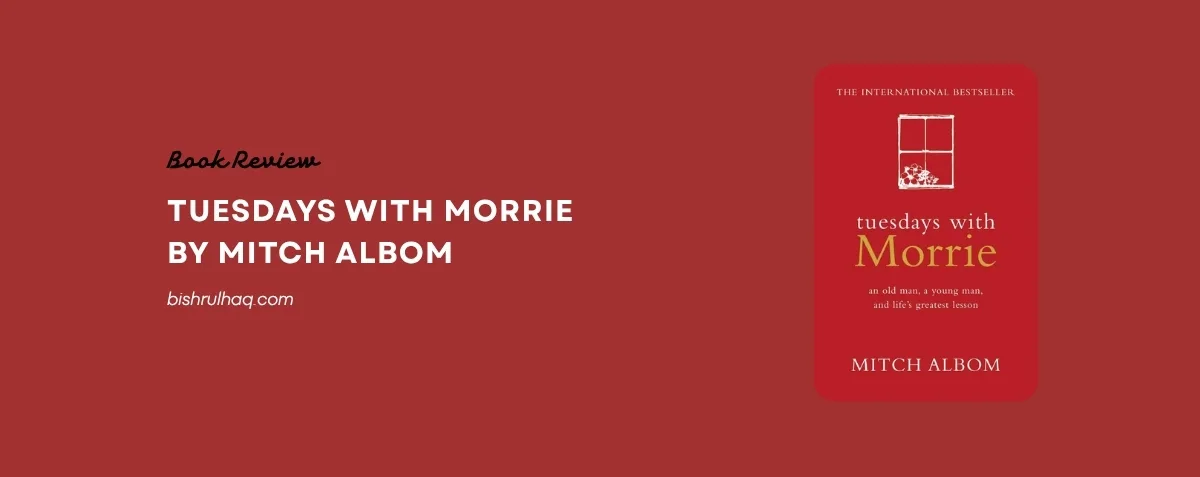
A book like Tuesdays with Morrie almost invites cynicism because it is openly sincere. It does not hide its lessons behind irony. It does not pretend death is a clever metaphor. It sits beside a dying teacher and listens.
I think that sincerity is the reason it still works. Some subjects do not need a more complicated style. Love, aging, work, family, regret, forgiveness, and death are already large enough.
A small book with final questions
This is a short book, but it carries the weight of a much larger one. Albom visits his old professor Morrie Schwartz as Morrie is dying, and their conversations move through work, love, family, regret, aging, forgiveness, and death.
Mitch Albom's visits with Morrie Schwartz give the book its structure. Each Tuesday becomes a small classroom, but the subject is not academic. It is how to live when the end is no longer abstract.
The book's power comes from the contrast between ordinary conversation and ultimate stakes. Morrie is not speaking from a stage. He is speaking from a body that is failing, which makes his attention feel unusually clean.
Lessons from Morrie
- The book is simple on purpose.
- Its best moments are tender without needing to be clever.
- Morrie's wisdom lands because it is spoken from the edge of time.
Why the simplicity helps
The best parts are the ones that make common wisdom feel earned. Spend time with people you love. Do not worship work. Forgive. Accept aging. Build a life around affection, not performance. None of that is new, but Morrie's condition removes the reader's excuses.
I liked that the book keeps returning to presence. Morrie gives people his attention as if attention is a final form of generosity. In a distracted culture, that feels less sentimental than it sounds.
The book also made me think about how much of life is spent chasing approval from systems that will not sit with us at the end. Career matters. Money matters. But the book keeps asking whether they matter in the right proportion.
Why the smallness is the strength
This book would not be better if it tried to be more sophisticated. Its smallness is part of its strength. The chapters feel like visits, and visits are not supposed to be overly polished. They are supposed to be present.
Morrie's lessons are simple because the end of life makes many clever things look less important. That does not mean the lessons are easy. Loving well, forgiving, accepting dependence, resisting status, and making peace with death are not easy at all.
I kept thinking about the teacher-student relationship at the centre of the book. There is something moving about learning from someone after the formal classroom is gone. It suggests that the best teachers continue teaching through the way they face life, not only through what they explain.
The book also works because Mitch Albom is not presented as already wise. He arrives with the busyness, ambition, and emotional distance many readers recognise. Morrie becomes a mirror for the life Mitch has been building and the life he may still choose.
That is why the book is more than a sad story. It is a question about attention. What do you keep postponing because you assume there will be time? Who gets your tenderness only after everything else is done? The book makes those questions difficult to ignore.
The conversation it asks for
The action after this book should probably be a conversation, not another note in a reading app. There is likely someone you love, miss, owe, or need to thank. The book's simplicity becomes powerful when it moves you toward that person.
I also think the book asks readers to reconsider what success looks like when time gets honest. If the people closest to you only get your leftover self, the book will not let that feel normal for long.
That is why the book can be reread at different ages. The lessons do not change much, but the reader does. A sentence about family, regret, or death lands differently depending on what life has already asked from you.
Who should read it without rushing
This is a good book for anyone who wants a short read that still leaves a mark. It is especially useful during grief, transition, burnout, or any season where the usual prizes have started to look thinner than before.
It is also a good recommendation for readers who do not normally read heavy nonfiction. The story carries the lessons gently. You can finish it quickly, but it is better if you let it slow you down.
What works and what does not
✓ What works
- Warm, readable, and emotionally clear
- A good reminder of what actually matters
- Short enough to read in one or two sittings
✕ Where it falls short
- Some readers may find it sentimental
- It does not hide its lessons inside subtle prose
- The structure is simple and familiar
Why some readers resist it
Some readers will find it sentimental. I understand that. The book is direct about its feelings, and directness can feel too easy if you are allergic to obvious lessons.
But I would be careful with that criticism. Sometimes we call a book sentimental when it is simply brave enough to say what we already know and keep avoiding.
How to carry the book gently
I would use the book by calling one person you keep meaning to call. That sounds almost too basic, but the book's lessons are basic in the best sense. They belong at the base of life.
I would also ask what your own Tuesdays are. Who teaches you how to live? Who gets your unhurried attention? What conversation would you regret postponing if time became suddenly visible?
What makes it last
I would rather a book be sincere and useful than clever and empty. This one is sincere all the way down, and that is why it still works.
The book lasts because it is not trying to impress the reader. It is trying to remind the reader. That is enough.


Comments
0No comments yet. Be the first to share your thoughts.