
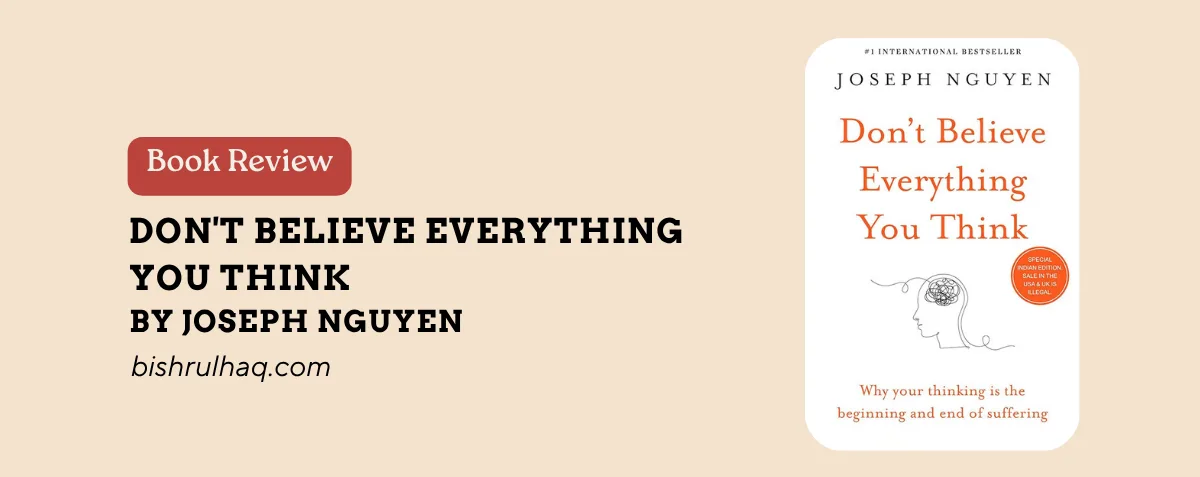
I read this book on a bus from Matara to Badulla and finished it before I got off. It took me just three and a half hours to finish the book. That is not a criticism. That is the whole point. Nguyen wrote it to be short on purpose. He is trying to say one thing, and he refused to let a publisher pad it out into the kind of three-hundred-page hardcover that the bestseller shelf prefers.
The one thing
The one thing is this. Your thoughts are not the same as reality, and most of the suffering you experience comes from believing that they are. That anxiety in your chest about next week's meeting. The replay of an argument from yesterday. The story you tell yourself about why your wife looked at you the way she did in the kitchen this morning. None of that is happening outside your head. It is all thinking.
If you have read any Buddhist or Stoic material, or any half-decent book on cognitive behavioural therapy, this idea will not be new to you. Nguyen doesn't pretend that it is. What he does, which is genuinely rare in the self-help genre, is strip the idea down to something you could explain to a teenager in one sitting without losing the core of it. That is much harder to pull off than it sounds, and most authors fail at it by trying to sound profound.
What I liked
The format, first of all. Short chapters, sometimes only a page or two. No padding. No chapter titles trying to sound profound. It reads like somebody wrote down a core idea over a weekend and refused to let an editor turn it into a brick. In a genre that is notorious for stretching a ten-page essay into a two-hundred-page book, that kind of restraint is worth something by itself.
There is one passage somewhere in the middle of the book where Nguyen says something to the effect of: the moment you stop adding thought to a feeling, the feeling will move through you in about ninety seconds. I have tested this claim about a dozen times since reading it, and it is uncomfortably accurate. It turns out that the thing keeping a bad mood alive is not the event that caused it. It is the story you keep telling yourself about the event. Cut the story, and the mood runs out of fuel faster than you expect.
I also liked that Nguyen does not try to be the hero of his own book. A lot of self-help authors cannot resist inserting long sections about how they personally figured this out, and how transformed they are now, and how you too can become as transformed as them if you follow their system. Nguyen mostly keeps himself out of it. The book is about the idea, not about him.
What annoyed me
The book repeats itself. By about chapter twelve I felt like I was reading the same insight rephrased for the fourth time. I understand why Nguyen does this. He is trying to make the idea sink in at a level deeper than intellectual agreement. But at some point, repetition starts to feel like filler, even in a short book, and I think a careful editor could have trimmed another thirty percent without losing anything important. The core of the book would actually be stronger with less of itself in it.
The other thing is that the tone occasionally drifts into full guru mode. Phrases like "the infinite intelligence within you" made me wince a little on the page. If you are allergic to that kind of language, and I mostly am, you will have to squint through a few paragraphs and translate them back into plain English to get to the useful observation underneath.
Does it actually help?
Yes, in small ways, and only if you are willing to catch yourself mid-thought for a few weeks after finishing it. The book is not going to change your life. But it might change what you do in the two seconds after your partner says something that annoys you, which, in my experience, is where most of the actual damage in a relationship happens. The ability to notice a thought arriving before you act on it is a small skill with enormous downstream effects on everything.
I also found, and this surprised me, that the book was better as a re-read than as a first read. On the first pass I kept nodding along and thinking "yes, I already know this." On the second pass, a month later, I started noticing that I didn't actually know it. I just agreed with it. Those are very different things, and Nguyen is one of the few authors who successfully points at the gap between agreeing with something and living it.
Who should read this
Anyone who overthinks. Anyone who has ever laid in bed at two in the morning running through a conversation from three years ago. Anyone who has said out loud "I know I shouldn't be this worked up about this" and then stayed worked up anyway. If any of those sound like you, the book is worth one quiet evening of your time.
If you are already deep into meditation, therapy, or serious contemplative practice, this will feel like a beginner's pamphlet, and honestly that is fine. Hand it to somebody in your life who is not there yet, and let it do the gentle work of opening a door they have not noticed.




Comments
0No comments yet. Be the first to share your thoughts.