
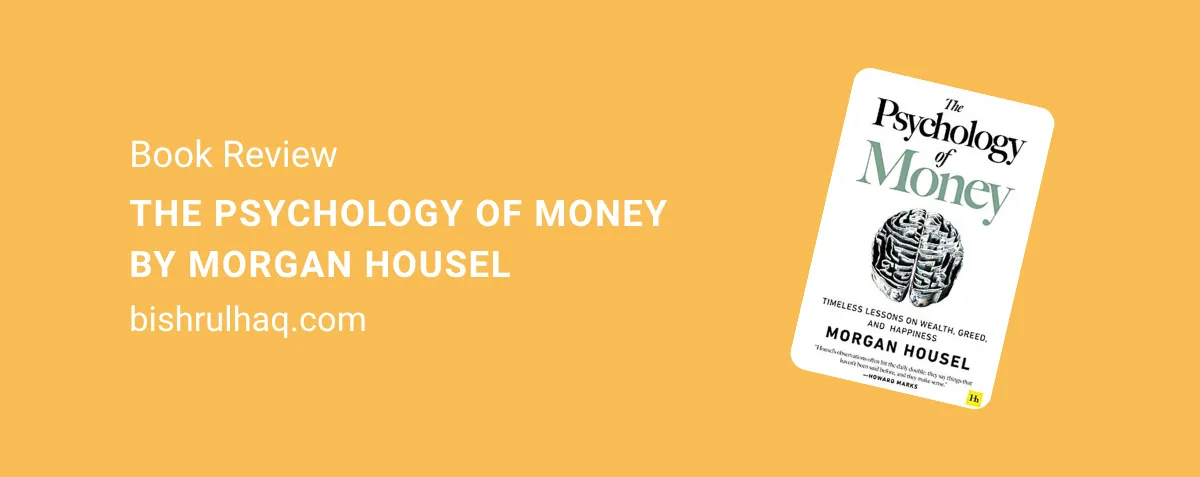
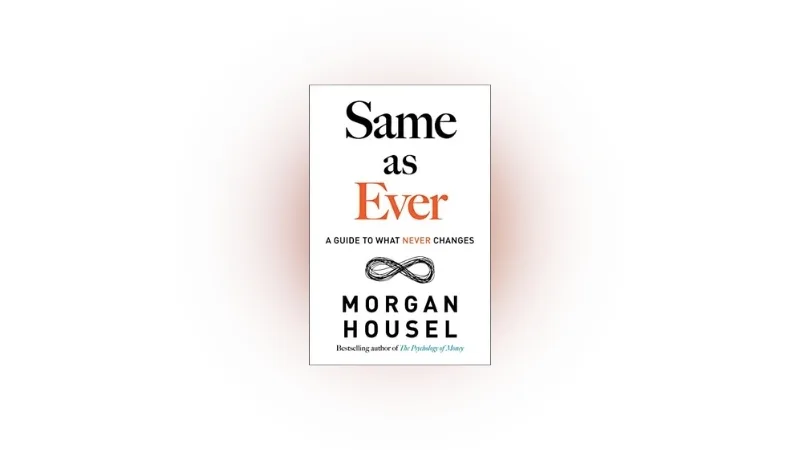
Most books about money are about math. This one is about people. That is the whole pitch of The Psychology of Money, and if you had told me in advance that this single sentence was enough to build a multi-million-copy bestseller around, I would not have believed you. Morgan Housel pulls it off, and it is the best book on money I have read in a very long time.
The premise
Housel's argument is simple, and he states it early. Financial outcomes in real life are driven far less by what you know about finance and far more by how you behave when you have money. A lot of people with MBAs end up broke. A lot of people who never finished high school retire comfortably. The difference is almost never raw intelligence or technical knowledge. It is patience, humility, and a clear sense of what game you are actually playing with your money.
The book is structured as a collection of nineteen short chapters, plus a postscript on the history of the American consumer. Each chapter is built around one core idea and one or two stories that illustrate it. You can read the book out of order. You can read one chapter per evening for three weeks.
It is shaped like an essay collection rather than a step-by-step guide, and the looseness of the structure is part of why it works so well. Housel is not trying to teach you a procedure. He is trying to teach you a way of seeing.
The chapter that rearranged my thinking
Chapter one is called "No One's Crazy," and it opens with an observation that has stayed with me for weeks. Every person's relationship with money is shaped by the narrow slice of economic history they personally lived through. Someone who grew up during a period of hyperinflation will treat money completely differently from someone who grew up in a stable decade, and neither of them is being irrational. They are reasoning from very different data sets.
I had never thought about my own money habits in that light before. Why am I slightly obsessed with having an emergency fund that most financial advisers would call excessive? Because I watched my parents sweat during a specific period in my childhood.
That is not a virtue I developed on purpose. It is a conditioned response, and once I saw that clearly, a lot of arguments I have had with friends about spending and saving suddenly made more sense. We were not disagreeing about the math. We were reasoning from completely different histories.
How this book differs from Rich Dad Poor Dad
I reviewed Robert Kiyosaki's book a few weeks ago, and I want to draw a direct contrast here because the two books circle similar territory with completely different temperaments. Rich Dad Poor Dad is a book about mindset dressed up with a fair amount of questionable specific advice. The Psychology of Money is a book about mindset that deliberately refuses to give specific advice, because Housel is honest about how much of finance is context-dependent and how quickly "smart" moves become "dumb" moves when the context shifts underneath them. One author is trying to sell you a worldview. The other is trying to make you think more clearly, and then leaves the actual decisions to you.
That distinction matters. The books that age best in this genre are almost always the ones that resist the urge to give you a recipe.
Lines I underlined
"Doing well with money has little to do with how smart you are and a lot to do with how you behave. And behavior is hard to teach, even to really smart people."
"The hardest financial skill is getting the goalpost to stop moving."
That second one especially. I have watched friends make more and more money every year and somehow feel poorer each year, because their internal definition of "enough" kept inflating faster than their income did. Housel names this pattern early in the book and returns to it in different forms throughout. Once you see it in your own life, you cannot really unsee it, and once you see it in a friend's life, you start to understand why some of them seem trapped no matter how much they earn.
What the book does not do
It will not tell you which stocks to buy. It will not teach you how to file your taxes. It will not explain compound interest in numerical detail. If what you need is a technical how-to guide, this is the wrong book. Pair it with something more procedural, and the combination will serve you better than either one alone.
What this book does, which most finance books do not even attempt, is fix the thing underneath the decisions. Most people do not need better information. They need a more honest relationship with the information they already have, and they need to stop reacting to every price movement like it is a personal attack. Housel is writing for the part of your financial life that the numbers never touch.
Who should read this
Everyone. I mean that literally. This is one of the rare books I think applies to people with no money, people with some money, and people with a great deal of money, because the underlying ideas scale in every direction. The worker saving their first hundred dollars and the investor managing their first million are both dealing with the same psychological traps, just wearing different clothes.





Comments
0No comments yet. Be the first to share your thoughts.