
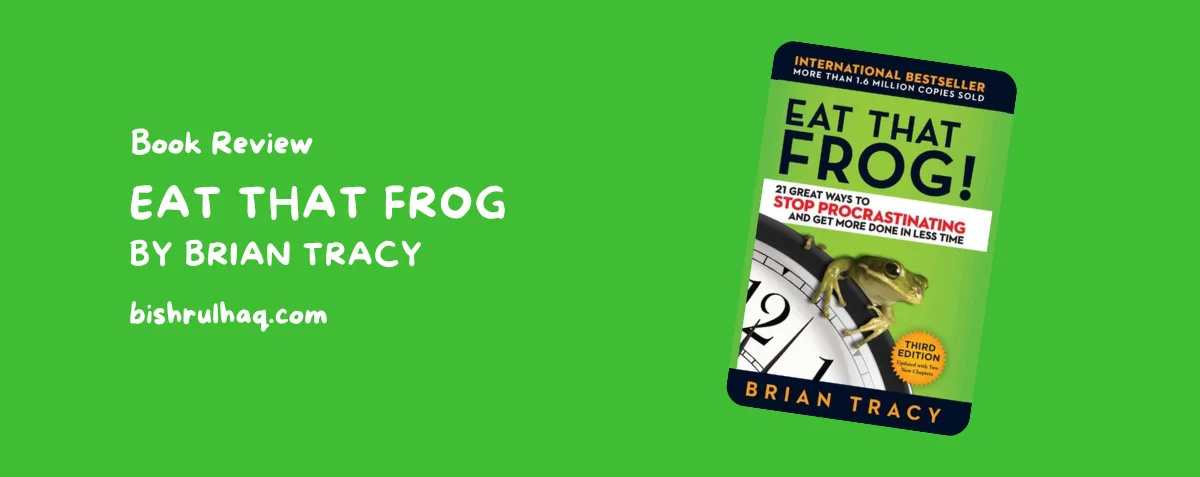
Brian Tracy's Eat That Frog is older than most of the productivity books people talk about on podcasts these days. It first came out in 2001 and has been quietly re-issued a few times since. I finally got around to reading it because someone in a work Slack channel described it as "Atomic Habits for procrastination, but shorter." That is not quite right, as I will explain, but it was close enough to get me to pick the book up.
The core metaphor
The title comes from a quote often attributed to Mark Twain, probably incorrectly, but it doesn't really matter. The quote goes: if the first thing you do in the morning is eat a live frog, you can go through the rest of the day knowing that the worst part is already behind you. And if you have to eat two frogs, eat the uglier one first.
Translated into normal language, what that means is this. Identify the single most important and most dreaded task of your day, and do it first, before you touch anything else. Not email. Not "easing into" your morning with small chores. Not that comfortable hour of setup work that feels productive but actually isn't. That thing. The frog. The task you have been avoiding all week and hoping will somehow resolve itself while you aren't looking.
That is the entire thesis of the book, in one paragraph. Everything else is elaboration, examples, and supporting frameworks around that one central instruction.
The frameworks that are actually useful
Tracy gives you a handful of tools inside the book, and a couple of them are genuinely worth keeping.
The first is the ABCDE method, which I have been using on and off since I finished the book. Before starting your day, you look at your task list and label every item. A is a task with serious consequences if you do not do it. B is a task with minor consequences. C is a task with no real consequences either way. D is a task you can delegate to someone else. E is a task you can eliminate from the list entirely. The rule Tracy lays out is that you never touch a B task while an A task is still undone. This sounds obvious on the page. It is not obvious in practice, because most people spend their mornings on C-level tasks that feel productive because they are easy to finish.
The second is the consequences test. When you are trying to figure out which task matters most, ask yourself what the long-term consequences will be of doing it, and what the long-term consequences will be of not doing it. The tasks with the biggest long-term consequences are almost always the ones you are avoiding, and that is not a coincidence. You avoid them because they matter, and because they are hard, and because your brain is trying to protect you from the friction of doing them.
The third is the 80/20 principle applied to daily work. This is not Tracy's original idea, obviously. It comes from Pareto. But Tracy uses it well. Twenty percent of your tasks account for eighty percent of your actual results. Your job is to figure out which twenty percent, and then protect them as if your career depends on it, because in a very real sense it does.
What has not aged well
Tracy writes like a motivational speaker from the late nineties, because that is essentially what he is. There is a lot of "successful people do X, unsuccessful people do Y" framing in the book that lands as a little too clean. Real life has more texture than that, and binary categorisation of humans into winners and losers is the kind of move the book would honestly be better without.
He also assumes, throughout, that you have full control over your own schedule, which is not true for most people who have an actual job. If your frog requires three other people to join a meeting before you can even begin eating it, the advice to "just eat it first thing in the morning" is not actually actionable. You need someone else's frog first. Tracy does not really engage with this, and it is probably the biggest weakness of the book for modern office workers reading it.
Eat That Frog versus Atomic Habits
These two books are trying to solve different problems, even though they often end up on the same shelf next to each other. Eat That Frog is a book about prioritisation. It is about what to do. Atomic Habits is a book about consistency. It is about how to keep doing anything at all over a long enough timeframe. If you have the time to read only one of them, and you are not sure which you need, read Atomic Habits first. Consistency is the harder problem for most people. If you already know which problem is killing you, and it is prioritisation rather than follow-through, then this book is your pick.
Who should read this
People who finish every day feeling busy but not productive. People who are allergic to long books and want a three-hour read they can actually finish on a single flight. People who suspect they are spending their best mental energy on their worst and most avoidable tasks, and who want a clean framework for fixing that pattern without having to invent one themselves.

Comments
0No comments yet. Be the first to share your thoughts.