
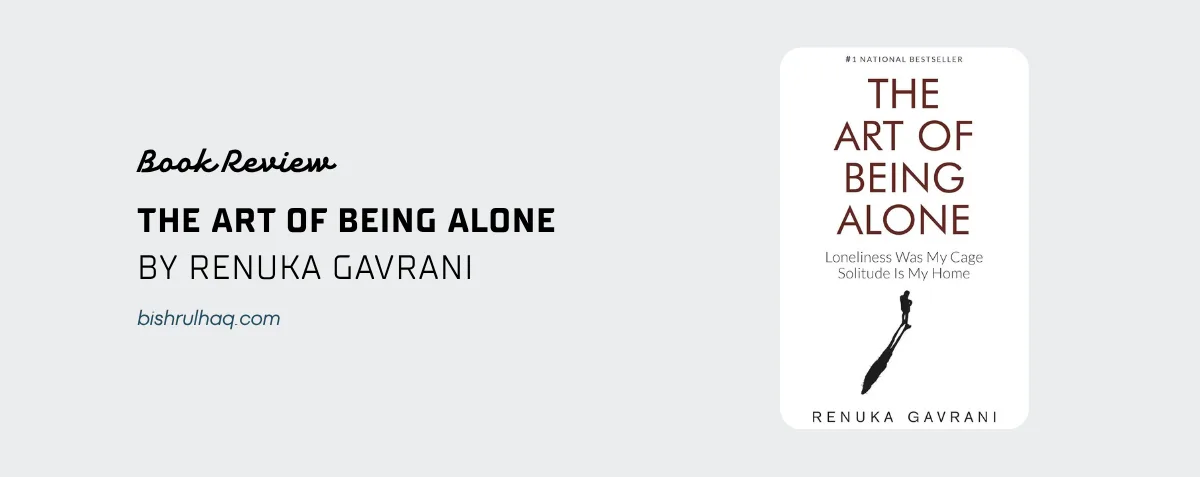
I bought The Art of Being Alone slightly defensively. I was going through a stretch where friends had moved cities, my calendar was quiet, and I was asking myself whether I was doing something wrong. I wanted someone to tell me that the problem was not me. What I got instead was a book that gently argued the problem was not a problem. It was a skill I had not yet learned.
Alone versus lonely
Renuka Gavrani's first move is to split a word most of us use carelessly. She argues that loneliness is a feeling of lack. You want something you do not have. Being alone is a condition. You are by yourself. These are not the same thing, and the book's whole project is to help you stop confusing them.
You are not lonely because you are alone. You are lonely because you have not yet learned to be the kind of company you would want to keep.
That line rearranged something for me. Most of the time when I have felt lonely it was not because I was short on social plans. It was because I was tired of my own inner monologue and did not know how to be with myself without distracting myself out of it.
Why this book landed for me as someone in software engineering
Software engineering is a strangely solitary profession, even when you work on a team. You spend the majority of your productive hours in your own head, debugging, modelling, reasoning through edge cases. You learn to like being alone, because that is where the real work happens. Then the weekend comes and the same habit that makes you good at your job makes you quietly unwell, because you haven't built a second mode for being alone that is not work.
Gavrani's framing was helpful for me on this exact point. She treats solitude the way a musician treats practice. It is a discipline you get better at. You don't just collapse into it. You show up for it. You protect it. You notice what it asks of you.
What the book actually prescribes
It is not a theoretical book. Each chapter ends with practical prompts. A few that I actually tried:
- Spend an evening without any input. No phone, no podcast, no show, no scrolling. Cook something. Sit with what comes up. Do not try to produce anything.
- Eat one meal alone in public without distractions. Genuinely harder than it sounds. I felt visibly awkward at a cafe the first time. By the third time it felt like something I wanted to keep doing.
- Write a letter to yourself from the version of you who has already figured out how to enjoy solitude. Sounds cheesy. Was useful. What that letter said to me was mostly about slowing down and stopping performing.
- Make a list of activities you enjoy that require no one else. Reading, walking, cooking, writing, drawing, running. Protect those hours the way you would protect a meeting.
These are not new ideas. The book's strength is not originality. It is compression. Gavrani takes what you might find scattered across twenty articles and stitches it into something short and repeatable.
Where it is weaker
The book is not written as a literary masterpiece. The sentences are sometimes a little too bloggy. Some chapters could have been cut in half. There is a strong self-help cadence that will not work for everyone, especially if you are used to the denser, more literary books in this space.
It also skates lightly over the truly hard version of loneliness. Clinical isolation, long-term social pain, grief. The book's tone is mostly pointed at the reader who is not in crisis, just in drift. If you are in a darker place than that, this book is not going to be the one.
A line that stayed with me
Solitude is a room you furnish. If you never enter it, of course it feels cold when you do.
That image stuck. I started thinking of my Sunday afternoons as a room I had neglected. I hung some things on the walls. I bought a better chair. I stocked the shelves with books and records I actually wanted to reach for. The metaphor made the work feel small and doable.
How my week changed
The practical shift for me, after finishing the book, was small but measurable:
- I stopped treating empty Saturdays as a sign that something was wrong.
- I started a walk-without-phone habit that I still have.
- I let one or two friendships breathe without panicking that distance meant death.
- I became better company in the social plans I did have, because I was not arriving starved for interaction.
That last one surprised me. Being better at being alone made me better in groups. Less grabby. Less performative. Less needing to be entertained.
Who should read it
People in their late twenties or thirties who have suddenly found that their social gravity has weakened. Engineers, writers, remote workers, anyone whose profession already has them spending lots of hours with their own thoughts and who want to stop treating those hours as a problem. Anyone coming out of a long relationship and rebuilding a life shaped differently.
Skip it if you want a dense, literary, philosophical treatment of solitude. Read Anthony Storr or Thoreau for that. Read Gavrani when you want practical help getting through a quiet Tuesday night. A small final thought: the quality of my time with other people has gone up noticeably since I got more comfortable being alone. That is the paradox the book ends on, and I think it is right.
I'll keep the book on my shelf next to a small stack of others I hand to friends at the right moment. Not because it is the deepest thing written on the subject, but because it is the most handable. Sometimes the right book is not the one that changes your life in a thunderclap. It is the one you finish in a weekend and find yourself quietly applying on a Tuesday evening without even meaning to. This was that kind of book for me.

Comments
0No comments yet. Be the first to share your thoughts.