
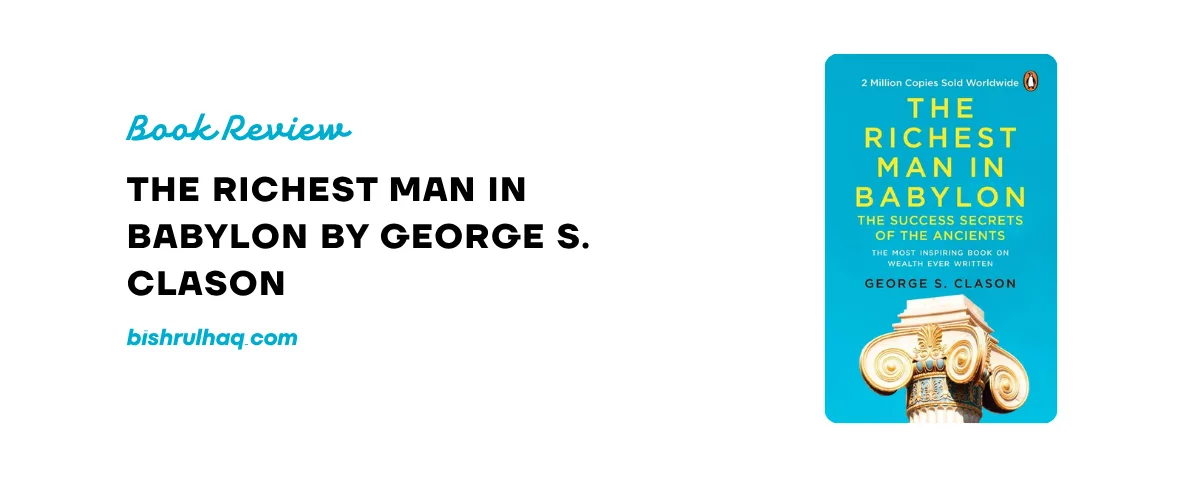
This is the oldest book on personal finance I have ever recommended to anyone. George S. Clason first published these parables in the 1920s, and he wrote them in a deliberately archaic style, as if ancient Babylonian merchants were advising you in King James English. The style takes about twenty pages to get used to. After that, it disappears, and the arithmetic underneath is startlingly modern.
What the book actually is
The Richest Man in Babylon is a collection of short stories set in ancient Babylon. The characters argue about money over meals, get into trouble, recover from it, and occasionally seek out the wisdom of Arkad, the richest man in the city. Each story delivers one or two principles, and by the end of the book you have a compact toolkit for managing personal finances that has held up remarkably well across a hundred years of economic change.
The framing device is important. Clason could have written this as a dry financial primer, and nobody would remember it. By wrapping the lessons in stories about real people losing real money, he makes the principles stick. You do not simply read "save ten percent of what you earn." You read about a man who failed to save anything and another who saved diligently, and you watch their lives unfold over decades. That is much harder to forget.
The Seven Cures for a Lean Purse
The central principles appear in a chapter called "The Seven Cures for a Lean Purse." Listed in modern language, they look like this.
- Save at least ten percent of everything you earn, before you do anything else with it.
- Control your expenses and live beneath your means, regardless of income level.
- Make your savings work for you by investing in things that produce more money.
- Guard your capital carefully and take advice only from people who have earned the right to give it.
- Own your home, so that housing is not a drain on your income for life.
- Secure a future income through insurance and long-term planning.
- Increase your ability to earn by continuously improving your skills.
If you read that list and it feels obvious, that is partly because personal finance writing for the last hundred years has been paraphrasing it. Clason said all of this first, or very close to first, in a form a fourteen-year-old could understand. Almost every financial book on a modern shelf is a modern paint job on one or more of these ideas.
The "pay yourself first" principle
The single most durable idea in the book is the one about saving ten percent. Clason frames it as paying yourself first. Before your landlord, before the merchants you owe, before any bill or entertainment expense, you take ten percent of your income and keep it for yourself. It is not a saving-what-is-left strategy. It is a take-it-off-the-top strategy, and the difference between those two approaches is the difference between accumulating money over a lifetime and never getting anywhere.
I set this up as an automatic transfer the week after I finished the book, years ago, and it is probably the single highest-return adjustment I have ever made to my finances. The money moves on payday. I never see it sitting in my main account. I have not missed it. That is the whole mechanism, and it is so simple that most people refuse to believe it will actually work until they have run it for a year or two and watched the balance climb.
The lesson about advice
There is a chapter in the book called "The Five Laws of Gold" that drives home something most modern finance books are too polite to say. One of the laws warns against taking investment advice from people who have not proven they can manage money themselves. Clason illustrates this with a story of a merchant who loses a large sum to a smooth-talking salesman because he ignored this rule and then spent the rest of his life trying to recover from it.
I think about this every time a cryptocurrency trend sweeps through a group chat, or every time a friend who has never run a business starts offering opinions on how I should run mine. Clason's rule is that you should only listen to people whose specific success is in the thing they are giving you advice about. That is a tougher filter than most of us actually use, and running your money through it for a month is a humbling exercise.
What the book misses
The archaic style is charming until it is not. A few of the stories repeat beats that have already been established in earlier chapters, and the female characters are given very little to do. The investment advice is also vague in a way that would not hold up to modern scrutiny. Clason can tell you to put your savings to work, but he cannot tell you what index funds are, and the specific investment vehicles he mentions were already outdated by the time my parents were born.
That does not make the book useless. It just means you should read it for the mindset rather than for a specific portfolio strategy. The principles are durable. The tactics need updating. If you want the tactics, pair this book with any modern index-fund primer and you will have everything you need to get started.
Why the parable format works
There is something the stories do that a straightforward financial guide simply cannot. Because Clason shows you consequences over time, the book teaches a quality that most personal finance writing fails to teach, which is patience. The characters in these stories do not get rich quickly. They save steadily, invest carefully, make mistakes, recover, and accumulate wealth over decades. That is what actually happens to most people who end up financially secure, and watching it play out in narrative form is a better education than reading a chapter on compound interest.
I would argue the parable format is the reason the book has survived. The ideas are not unique. The delivery is.
Who should read this
- Anyone who has never thought carefully about where their paycheque goes each month.
- Teenagers and young adults who are just starting to earn money and need a simple frame before the internet confuses them with a hundred conflicting strategies.
- Readers who prefer principles wrapped in stories, because the parable format makes these ideas stick in the memory in a way that textbook prose never quite does.
- People who have read a lot of modern personal finance content and feel lost in the details, because this book strips the subject back to its simplest possible shape.
It is old. It is a little clunky in places. It is also, for a first book on money, still one of the best pieces of advice I can offer. Read it before you read anything else in the personal finance aisle. Everything else will make more sense once you have this one in your head.


Comments
0No comments yet. Be the first to share your thoughts.