
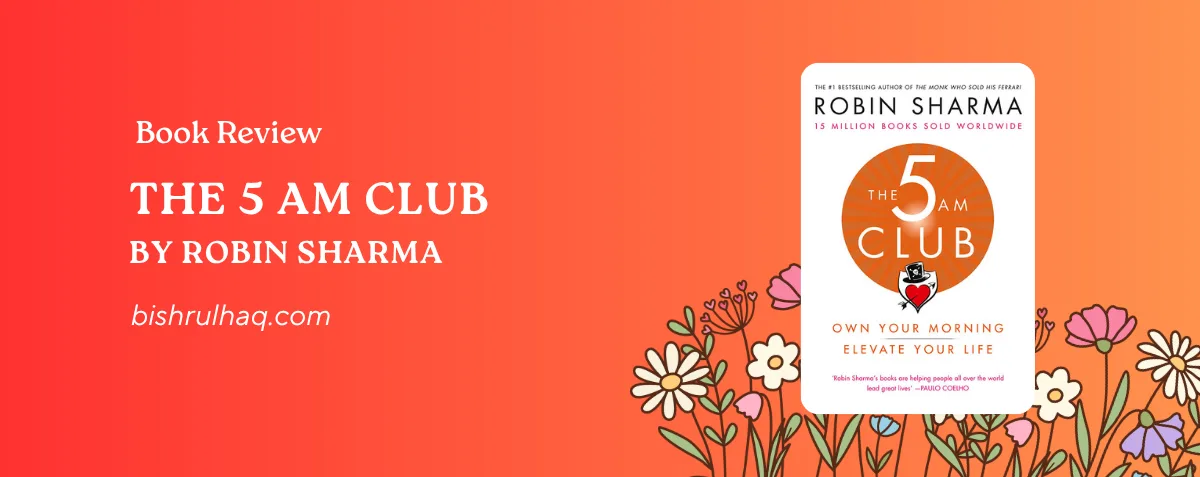
Let me start with full disclosure. I am not a morning person. I wake up at 5:30 on a good day and closer to 6:30 on a bad one. My most productive hours as a human being are between 10pm and 12am, when the rest of the world has finally stopped asking me things. The idea that joining a "5 AM club" is going to unlock hidden reserves of potential inside me sounds, on its face, like the kind of thing sleep-deprived executives tell themselves so that they feel better about being sleep-deprived.
So when a friend pushed this book on me, I opened it with my eyes already rolling. I did roll my eyes, a few times, and I am going to talk about that. But I also finished it, which means something, because I abandon about a third of the books I start.
The first problem is the format
Sharma wraps his advice inside a story. The story involves a billionaire, a failed entrepreneur, and a stressed-out artist who all happen to be at the same luxury personal development event at the start of the book. The billionaire takes the other two under his wing and spends the next three hundred pages teaching them about the power of rising at 5am. They travel together. They visit tropical islands. There are long, slow monologues delivered on white sand beaches while the sun rises. At one point, somebody meditates on a yacht.
It is a lot. If you are allergic to the genre of "fable disguised as self-help," and I mostly am, you are going to spend a large fraction of this book wincing at the dialogue. Characters say things like "ah yes, my dear friend, this reminds me of what the great masters of old have always known" and then deliver an observation that could have fit into a single clean sentence. The story frame is meant to make the ideas memorable. For me, it mostly did the opposite. It made me want to find the essay version and read that instead.
The actual ideas, underneath the story
If you strip out the fable and focus only on Sharma's actual claims, you are left with a handful of things that are genuinely useful.
The first is the 20/20/20 formula. The first hour after you wake up is divided into three twenty-minute chunks. Twenty minutes of intense physical activity to get your body moving and your head clear. Twenty minutes of reflection, journalling, or planning for the day. Twenty minutes of learning something new, whether that is reading a book or listening to a lecture. I have actually tried a version of this framework, just at 7am instead of 5am. The time slot turned out to matter less than I expected. The structure of "move, reflect, learn" as the opening to your day is genuinely good, regardless of when you start it.
The second is the idea of a "victory hour," which is Sharma's name for the first hour of your day before the world has begun to make demands on you. This is a real thing, not just a branding exercise. If you can protect even forty-five minutes at the start of your morning from your phone, your inbox, and the voices of other people, the rest of your day will feel measurably different. I do not fully understand why this is true. I only know that I have tested it enough times to stop arguing with the evidence.
The third, and the one that genuinely surprised me, is a throwaway line somewhere in the middle of the book. Sharma writes, roughly, "if the mob applauds you, you are doing it wrong." His point is that mastery is mostly boring, mostly solitary, and mostly invisible to other people, and if you are getting a lot of social rewards for your process rather than your results, you are probably optimising for the wrong thing. That one landed harder than anything else in the book, and I have thought about it a lot since.
Where the book falls apart
The book is at least three times longer than it needs to be. A tight version of this would fit into a fifty-page essay, or possibly a twenty-minute podcast, and the repetition gets genuinely tiring by the halfway point. I don't know who Sharma's editor was, but I suspect they were told not to cut anything. The book would have been better if someone had been willing to say no to him.
I also think Sharma, like a lot of authors in this space, quietly conflates two very different claims. The claim "many successful people wake up early" is probably true. The claim "waking up early is what makes you successful" does not follow from the first one, and the book never quite separates them. Correlation is carrying an enormous amount of weight in that argument, and nobody inside the book is auditing it.
Did it convert me?
No. I did not join the 5 AM club. Yes, sometimes I do get up early, but I am not a morning person. My body simply does not work that way, and I stopped pretending otherwise a few years ago. What I did take away from the book is the idea of protecting the first hour of whenever I wake up as a no phone, no inbox, no other humans window.
Sharma would probably say that is not the same thing, and he would be technically right. But it is what works for my particular nervous system, and I am going to trust that over a slogan.
Who should read this
If you already want to be a morning person and just need permission, a framework, and a little bit of motivation to lock in, this book will serve you well. If you are already a morning person, you will nod along and feel validated, which is its own kind of pleasure. If you are me, read a decent summary and save yourself several hours.




Comments
0No comments yet. Be the first to share your thoughts.