
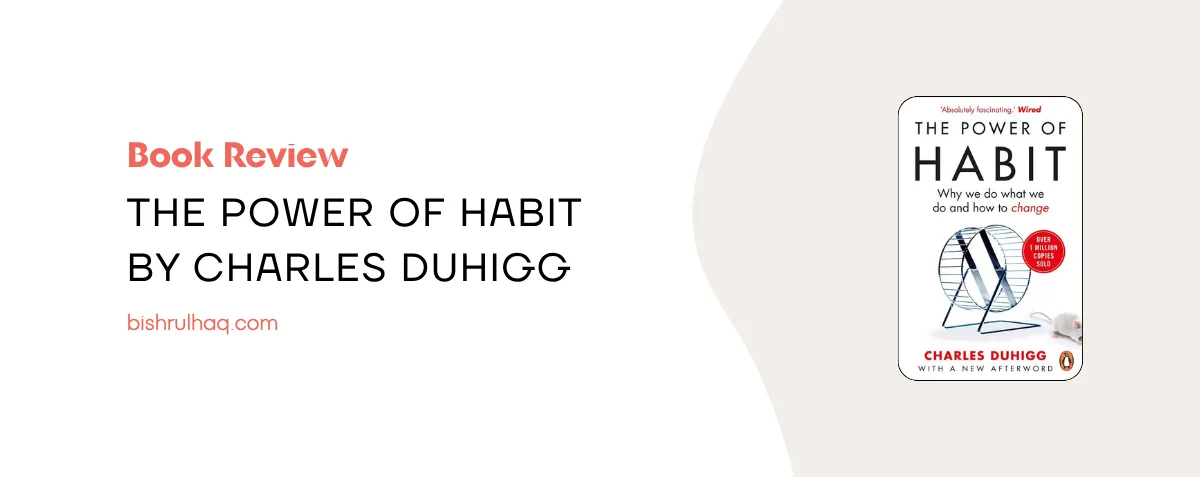
Every productivity book written in the last decade owes something to The Power of Habit. Duhigg was not the first person to write about habits, but he was one of the first to package the neuroscience, the behavioural research, and the case studies into something a general reader could finish on a holiday without feeling talked down to. It is still the book I would hand to someone who wants to understand why they keep doing things they have decided not to do.
The habit loop
The central framework of the book is the habit loop. Every habit, Duhigg argues, has three parts.
- A cue, which is the trigger that starts the behaviour.
- A routine, which is the behaviour itself.
- A reward, which is the payoff your brain gets for completing the routine.
Once a loop has been repeated enough times, the brain stops deliberating and the behaviour runs on autopilot. This is why you can drive home from work without remembering any specific turn you took, and also why you can eat a whole bag of crisps without noticing. The loop is efficient, which is usually good, and it is also hard to unlearn, which is often bad. Most of the bad habits people want to break are not complicated. They are simply loops that have been running for a long time and have grooved themselves deep into the wiring.
The cookie experiment
Duhigg spends a chapter on his own experience trying to break a habit of walking to the office cafeteria every afternoon and buying a cookie. He had assumed the reward he was seeking was the cookie itself. When he investigated carefully, tracking what he did and how he felt before and after the cookie, he found out the real reward was the short social break. The walk, the chat with coworkers, the change of scenery.
Once he knew that, the intervention became obvious. He started walking to a colleague's desk for a chat at the same time each afternoon instead, and the cookie habit dissolved within a couple of weeks. This is the whole book in one story. You do not change a habit by attacking the routine. You change it by identifying the real reward your brain is chasing and finding a different way to deliver it. That is a subtle point, and Duhigg is one of the few authors who illustrates it cleanly enough that a reader can actually apply it.
Keystone habits
The second idea worth keeping from the book is the notion of keystone habits. These are habits that, once in place, quietly rearrange the rest of your life. Exercise is the classic example. People who start exercising regularly often find themselves eating better, sleeping better, and drinking less alcohol, not because they decided to, but because the keystone habit shifted the surrounding system. Making the bed in the morning is another classic example in the book, and it sounds trivial until you actually try it.
This matters because most people try to change ten things at once and burn out by the end of January. The keystone framing suggests the opposite. Find one high-leverage habit, install it cleanly, and let the downstream changes happen on their own. It is a slower approach. It also works much more reliably, because you are not relying on willpower to hold up ten separate new behaviours at once.
The corporate chapters
Duhigg spends a meaningful portion of the book on how habits operate inside organisations. He tells a long story about Paul O'Neill turning around Alcoa by focusing on worker safety as the keystone habit that pulled every other part of the business into line. He talks about how Starbucks trains its staff to handle moments of stress by drilling specific routines into them. These chapters are well-reported and consistently interesting, and they are also the part of the book that readers either love or quietly skip.
I liked them more the second time around. The first read, I was hungry for personal habit advice and impatient with the detour into business stories. The second read, with a few years of experience managing small projects, the organisational chapters suddenly made sense. Habits are not just personal. A team has habits. A company has habits. Most organisational dysfunction is just a bad habit that has been running for too long without anyone noticing.
What the book does less well
The final section on social movements and the neurology of free will is noticeably weaker than the first two. Duhigg spends several chapters on organisational and societal habits, and while the material is interesting, it does not earn its place in a book called The Power of Habit. The Rosa Parks chapter in particular reads like a long-form magazine feature that wandered into the wrong manuscript.
If the book had ended at the personal habits section and let the organisational material become its own separate essay collection, the result would have been tighter. As it stands, the last third is the part most readers remember least well, and that is usually a sign that it should not have been there in the first place.
How this book pairs with other habit books
I usually recommend reading The Power of Habit and Atomic Habits together, in that order. Duhigg explains the why. James Clear gives you the how. Duhigg gives you the mechanism and the research. Clear gives you the playbook and the specific tactics. Neither book is complete without the other, and either one on its own leaves you with half the picture. If you only have time for one, Atomic Habits is the more practical of the two. If you have time for both, read this one first.
Who should read this
- Anyone who has tried to change a habit by willpower and watched willpower lose.
- Parents and teachers who want to understand why their kids keep doing the same thing after being told a hundred times to stop.
- People building apps or products, because the habit loop is a useful lens on why certain products become sticky and others do not.
- Managers and operators who want to understand why their team keeps producing the same problems even when everyone agrees the problems need to stop.
Pair it with Atomic Habits and you have the two best books on the topic in print. Read The Power of Habit first for the theory, and Atomic Habits second for the practical playbook. A year later, read them again. The second reading teaches you what you missed on the first, which is usually quite a lot.



Comments
0No comments yet. Be the first to share your thoughts.