
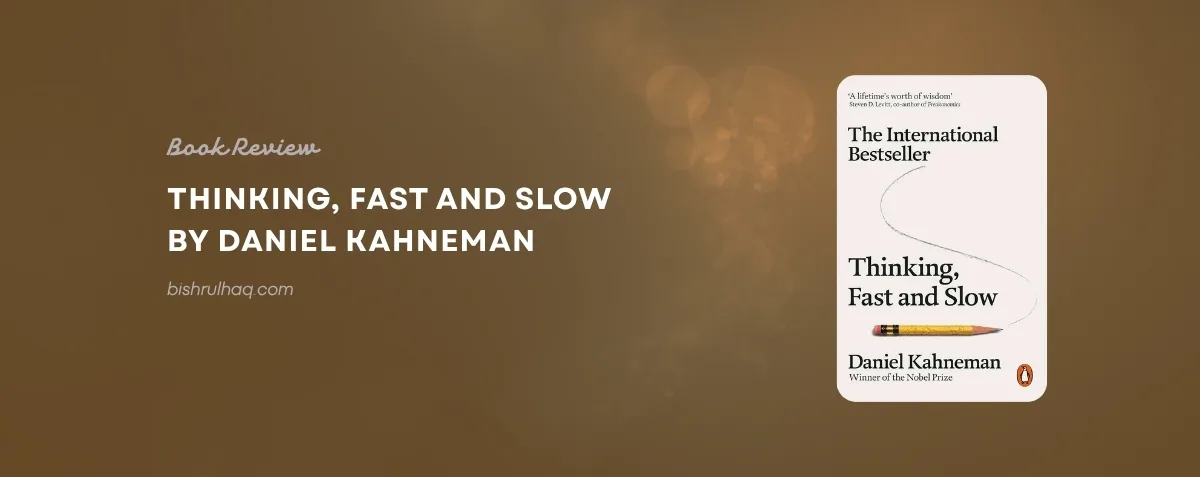
This is the kind of book that makes you distrust your own confidence in a useful way. Daniel Kahneman does not write like someone trying to entertain a tired reader on a short commute. He writes like a patient teacher taking apart the machinery of judgment piece by piece.
I had to read it slower than I expected. That is not a complaint. Some books are not meant to be swallowed quickly. They are meant to interrupt the way you explain yourself to yourself.
A map of the mind's shortcuts
This is not a quick book, and it should not be treated like one. Kahneman patiently explains how the mind uses shortcuts, how confidence can mislead us, and why we are often less rational than we think even when we feel careful.
The famous split between fast and slow thinking is simple enough to explain, but the book is not simple in its implications. System 1 is quick, automatic, and often helpful. System 2 is slower, more deliberate, and less eager to work than we like to believe.
The uncomfortable part is that intelligence does not exempt you. A smart person can still anchor on the wrong number, overtrust a story, ignore base rates, or confuse a good explanation with a true one. The book is full of small humiliations like that.
Psychology notes worth keeping
- System 1 is fast, intuitive, and often useful.
- System 2 is slower, effortful, and lazier than we like to admit.
- The most humbling sections are about confidence, prediction, and bias.
Why it feels humbling
The most valuable theme is not that humans are irrational. That is too easy. The better lesson is that our minds are adapted for speed, coherence, and survival, not for perfect statistical judgment. That makes mistakes understandable without making them harmless.
I kept thinking about how much we love stories. A neat story can make uncertainty feel settled. It can make random outcomes look deserved. It can make hindsight feel like insight. Kahneman keeps pulling the reader back from that comfort.
The sections on confidence and prediction are especially useful. People often sound most convincing when they have simplified reality too much. The book trains you to ask what information is missing, what base rate is being ignored, and whether the confidence is earned.
Reading it as a mirror, not a trophy
There is a tempting way to read this book as intellectual decoration. Learn the names of biases, mention System 1 and System 2, and feel sharper than the people who have not read it. That would be the least useful way to read Kahneman.
The better way is to read it as a mirror. Where do I jump to a story because uncertainty is uncomfortable? Where do I mistake a vivid example for a common one? Where do I trust confidence because it sounds fluent? Those questions make the book personal.
I found the planning fallacy especially uncomfortable. It is easy to smile at other people's bad estimates, then remember every project I thought would take one weekend. The mind does not only misjudge because it lacks data. Sometimes it misjudges because optimism is emotionally convenient.
The book is also useful for understanding arguments. People often debate from different stories rather than different facts. Once a story feels coherent, contradictory evidence becomes annoying instead of informative. Kahneman gives language to that human stubbornness.
What makes the book last is that it gives you suspicion without cynicism. You do not have to distrust every thought. You simply learn to treat first impressions as drafts. That is a small change with a large effect on decisions, money, work, and relationships.
The decision check I would keep
The simplest decision check from this book is to ask what information would make the current story less neat. That question matters because the mind loves coherence. Once a story explains enough, we often stop looking for the data that would complicate it.
I would also use the book to become slower with certainty. Not passive, not afraid, just slower. There is a difference between being decisive and being captured by the first answer that felt good. Kahneman makes that difference easier to respect.
Who will appreciate the weight of it
This is for readers who want the deeper foundation behind decision-making advice. If you like psychology, investing, management, product work, negotiation, or simply understanding why people misjudge things, it is worth the effort.
It is not a light motivational read. I would not pick it up when you want comfort. I would pick it up when you are ready to have your mental shortcuts named in public.
What works and what does not
✓ What works
- Foundational ideas for understanding judgment
- Makes cognitive bias feel personal, not academic
- Worth reading slowly with notes
✕ Where it falls short
- Dense and tiring in stretches
- Not written for quick motivation
- Some examples require patience from the reader
The patience it asks for
The main caution is density. The book can feel heavy, especially if you try to read it like a normal self-help book. It rewards pauses, notes, and rereading.
Another caution is false superiority. Learning about bias can make you better at spotting other people's mistakes than your own. That is probably the first bias the reader should watch after closing the book.
How I would use the ideas
I would use the book by slowing down important decisions. Ask what the base rate is. Ask what would change your mind. Ask whether a vivid story is doing too much work.
For everyday life, the simplest practice is to add a pause between confidence and action. Not forever. Just long enough to ask whether the fast answer is useful, lazy, or merely familiar.
What stayed with me
The gift of this book is humility. It does not make you immune to bias. It makes you less certain that your first confident answer is the whole truth. That is annoying, useful, and worth remembering later too.
The book did not make me feel smarter. It made me less eager to feel certain. That is a better outcome than it sounds.



Comments
0No comments yet. Be the first to share your thoughts.