
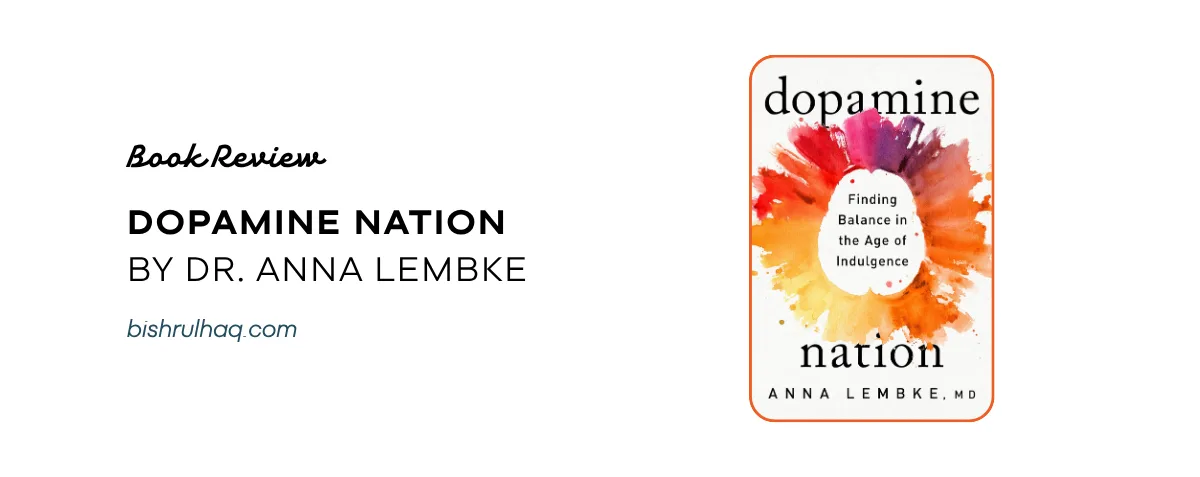
Every few years a book comes along that rewires a small but important part of how you see your own behaviour. Dopamine Nation did that for me. Anna Lembke is a psychiatrist who runs Stanford's addiction clinic, and she has written a book that is half patient stories and half hard neuroscience, with just enough personal confession to make it feel like she is not preaching from a clean perch.
The central idea, in plain language
Your brain has a balance between pleasure and pain. When you do something pleasurable, your brain responds with a matching push toward pain, just to bring you back to baseline. That is fine if the pleasure is occasional. The problem is that modern life gives you access to an endless, high-dose, high-frequency stream of pleasurable inputs. Short videos, food delivery, streaming, porn, work Slack dopamine hits, dating apps, online shopping. The balance tips hard toward pain. You end up needing more and more of the thing just to feel normal.
We are all, whether we admit it or not, trying to escape discomfort. And the modern world has made escape frictionless.
That is the book in one sentence. Everything else is her explaining the mechanism, showing you what it looks like in her patients, and then walking you through what actually helps.
The part that shook me
She describes addiction on a spectrum, not as a binary. You do not need to be a heroin user to be on the scale. A software engineer who cannot stop checking notifications, an overworked parent who needs three glasses of wine to unwind, a student mainlining productivity content, a middle-aged executive obsessed with his inbox. All of them are on the same map, just at different coordinates.
I caught myself in at least three of those. I pick up my phone without deciding to pick it up. I refresh metrics dashboards when I'm anxious. I work longer than I need to because the rush of finishing a ticket is easier than sitting with an unresolved feeling. Lembke puts language to all of that. It is not moralistic. It is clinical and kind.
What she actually prescribes
Here is where a lot of pop-neuroscience books fall apart. They explain the problem beautifully and then offer fluffy advice. Lembke offers a specific protocol that she uses with her patients and, by her account, with herself. She calls it the dopamine fast. The basic idea:
- Identify your drug of choice. Not just the obvious ones. The subtle ones too. Phone, shopping, work, gossip, news.
- Abstain for roughly thirty days. Not reduce. Abstain, if possible, completely.
- Expect the first two weeks to feel worse, not better. The pain side of the balance is rebounding.
- By weeks three and four, baseline pleasure returns. Things that seemed boring before start to feel enough again.
- Reintroduce carefully, with constraints you set in advance, so you can feel the difference.
She also talks about intentionally pursuing pain as a balancing counterweight. Cold water, hard exercise, fasting, anything where you take on a small, controlled dose of discomfort. The neuroscience behind this is fascinating and, unlike some of the content in this space, actually well-sourced.
My own experiment
After reading, I did a stripped-down version. No short-form video for a month. No metrics dashboards on weekends. No news apps on my phone. The first week was uncomfortable. I noticed how often my hand reached for a phone that no longer had the app it was looking for. By the third week my sleep was better, my attention span felt longer, and I was finishing a book every few days again.
That is anecdote, not data. But the fact that the book is specific enough that I could actually run the experiment is the part I respect.
Where it could be better
- Some of the patient stories blur together after a while. The structure starts to feel repetitive around chapter six.
- She mentions the role of the environment, but I wanted more on how to design your home and device setup to make abstinence easier. This is where a book like Atomic Habits goes deeper.
- The book is short, and sometimes you can feel the editor pushing her off of a topic she clearly wanted to explore more.
What stuck
A line I wrote in my notebook:
The paradox is that hedonism, the relentless pursuit of pleasure, leads to anhedonia, the inability to feel pleasure at all.
If you have ever had a weekend where you binged shows, ate well, slept in, and still felt flat on Sunday night, that line explains it. You did not do anything wrong. You just overran the pleasure side of your balance, and the brain dutifully tipped the other way.
Who should read it
Everyone with a smartphone. Specifically, people who feel like they have great technology, great food, great entertainment, and a strangely flat emotional baseline. Lembke is not here to make you feel guilty about your phone. She is here to explain, mechanically, why it is doing what it is doing, and to hand you one genuine tool to try.
This is one of the few health books I have recommended to friends three different times in three different contexts. That is usually a good sign.
One more thing that surprised me
Lembke spends a chapter on radical honesty as an addiction treatment. Her argument is that lying, including small social lies, depletes the same reserves that addiction depletes. Telling the truth more often, in low-stakes ways, strengthens the same system that helps you resist the pull of a compulsive behaviour. I did not expect that chapter in a book about dopamine. It is one of the ideas that has quietly stuck with me the longest. I lie less often now, even about small things like whether I actually liked a meal, or whether I'm busy on a given evening. It feels better than I expected it would. The small daily friction of telling the truth turns out to cost less than the cumulative drag of small daily fictions.
That is the real achievement of Dopamine Nation. It does not just explain one mechanism in the brain. It hands you two or three levers you can actually pull on, and the levers keep working months after you have closed the book. That is rarer than it should be.




Comments
0No comments yet. Be the first to share your thoughts.