
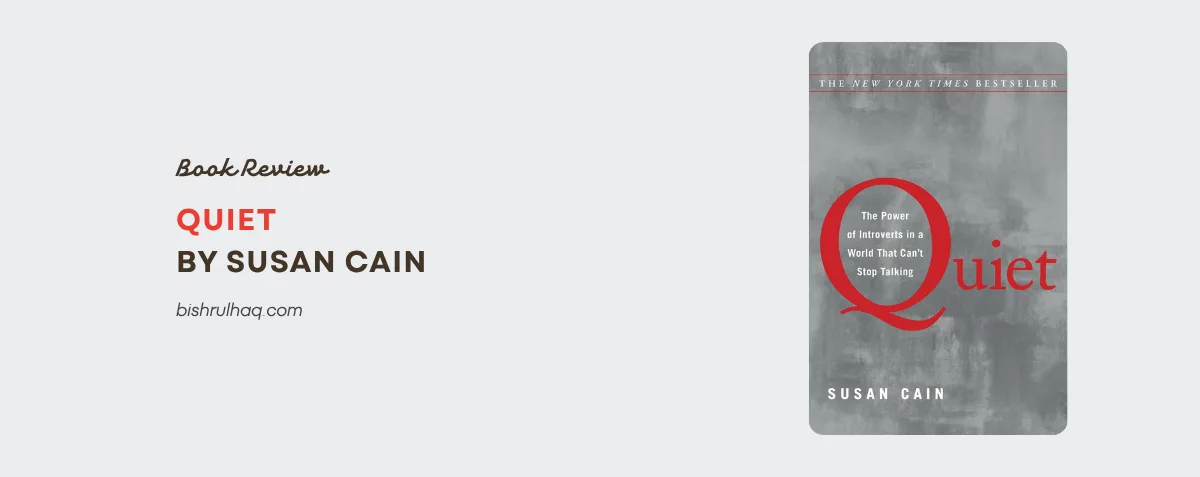
I had watched Susan Cain's TED talk at least three times before I finally read the book. Every time I told myself I had got the gist and could skip the longer version. That was wrong. The talk is the trailer. The book is the actual film, and the bulk of what made the talk land is in chapters that did not fit on stage. If you have only seen the talk, this is the rare case where the book does not just expand the argument. It repairs it.
What this review covers
- Why the TED talk is not enough, and what the book actually adds
- The "extrovert ideal" and the hidden tax half the room has been paying
- Restorative niches: the term I needed and what I built into my week
- Where the book wobbles, and who it serves best
What Susan Cain is actually arguing
The shorthand for Quiet is "introverts are great too." That is not what the book is saying, and Cain spends the first hundred pages pulling apart the simple version. Her argument is that the modern Western workplace, school system, and social culture have built themselves around what she calls the extrovert ideal, the assumption that the bold, talkative, group-oriented person is the better worker, the better leader, and the more well-adjusted human. Half the population, give or take, is wired differently, and that half has been spending most of its life paying a quiet tax to keep up.
Cain is also careful, repeatedly, to say that this is not a competition. The book is not a counter-claim that introverts are secretly superior. It is the more interesting claim that the costs of the extrovert ideal are real, and most of us are paying them without knowing. Some of us are paying as introverts pretending to be extroverts. Some of us are paying as extroverts who never learned what stillness is for. Either way, almost nobody is auditing the bill.
The chapter that justifies the price of the book
Cain spends a long stretch on the work of Jerome Kagan, a Harvard developmental psychologist who tracked babies into adulthood and discovered that you can predict an unusual amount of adult temperament from how a four-month-old reacts to balloons popping. Babies who startled easily, what Kagan calls high-reactive, tended to grow into careful, observant, often introverted adults. Babies who barely flinched grew into the opposite. Cain's argument, drawing on Kagan, is that introversion and extroversion are not styles you choose. They are biological starting points you arrive with.
That single idea reframed several years of work history for me. I had spent my twenties trying to be the kind of person who thrived in open-plan offices, three-hour group brainstorms, and after-work drinks where you were expected to remember everybody's name and shout above the music. I was not failing at any of these. I was paying a real, measurable cost to keep up, and then going home and crashing out of any meaningful evening because I had nothing left for the people who actually mattered. The book did not cure that. But it gave me language for it, and language is most of the cure.
There's zero correlation between being the best talker and having the best ideas.
The book defends this line with research, with case studies, and with examples that range from Rosa Parks to a study of brainstorming. Group brainstorming, in particular, has been shown to produce worse results than the same people thinking alone first and then comparing notes. I have been in that room a hundred times. I cannot stop seeing it now.
Info
Restorative niches: the term I needed
Cain borrows the phrase "restorative niche" from psychologist Brian Little. It is the place or activity that lets you recover from the social or behavioural performance you have been keeping up. Some find it in a coffee shop. Some find it on a long run. Some find it in a phone call with one specific person. Cain's point, gentle but firm, is that introverts who do not build these into their week burn out at a rate they often cannot trace to its source.
I started building these in deliberately after reading the book. Two short walks during the workday. A single morning a week with the phone off. Lunch alone, sometimes. Saying no to an evening invitation if there was already too much in the calendar that week. None of these felt selfish once I had a name for them. They felt like maintenance.
What I underlined
- "Solitude matters, and for some people it's the air they breathe."
- "Spend your free time the way you like, not the way you think you're supposed to."
- "The secret to life is to put yourself in the right lighting."
- "We don't need giant personalities to transform companies. We need leaders who build not their own egos but the institutions they run."
The third one is the line I think about most. Cain's argument, simplified, is that you do not need to change who you are. You need to find or build the contexts where who you are works. That is a softer claim than most career books make, and I think it is more accurate.
The book in balance
✓ What works
- Repairs the TED-talk version with research and case studies you do not see on stage
- The Kagan chapter on biological temperament is genuinely revelatory
- Restorative niches is a term you will keep using for years
- A quiet manual for working better with the half of the room that does not raise a hand
✕ Where it falls short
- Over a decade old now, and some workplace examples feel slightly dated
- A handful of chapters lean gently triumphalist for introvert readers
- The argument repeats itself in places it did not need to
- Open-plan office case studies have moved on since the book was written
Who should read it
- Anyone who has spent years assuming there is something quietly wrong with them because they need a long time alone after social events.
- Managers who keep building processes around brainstorms, town halls, and group decisions, and wonder why their best ideas keep showing up in one-on-ones.
- Parents of a child who is, in the language of school reports, "shy," and who would benefit from being told that shyness is not a problem to fix.
I would also hand it to extroverts who manage introverts. The book is not a defence of one type. It is, in the second half, a quiet manual for working better with the half of the population that does not raise their hand in the meeting and still has the better idea.
Final thought
I gave it four stars, slightly grudgingly. The fifth star was lost to the dated examples and a couple of chapters where the argument felt repeated more than it needed to be. The four stars, though, were real. Quiet changed how I structure my week, how I think about the people I work with, and how I read a room I am about to walk into. That is a lot of work for one book to do.
The line I keep returning to is Cain's quiet observation that the goal is not to become more extroverted. It is to put yourself in the right lighting. Most of the bad seasons in my career were seasons where the lighting was wrong, and I was blaming myself for not glowing under it. The book gave me a better question to ask. Not "what is wrong with me." Just "what does my next month need to look like, and can I shape it on purpose."




Comments
0No comments yet. Be the first to share your thoughts.