
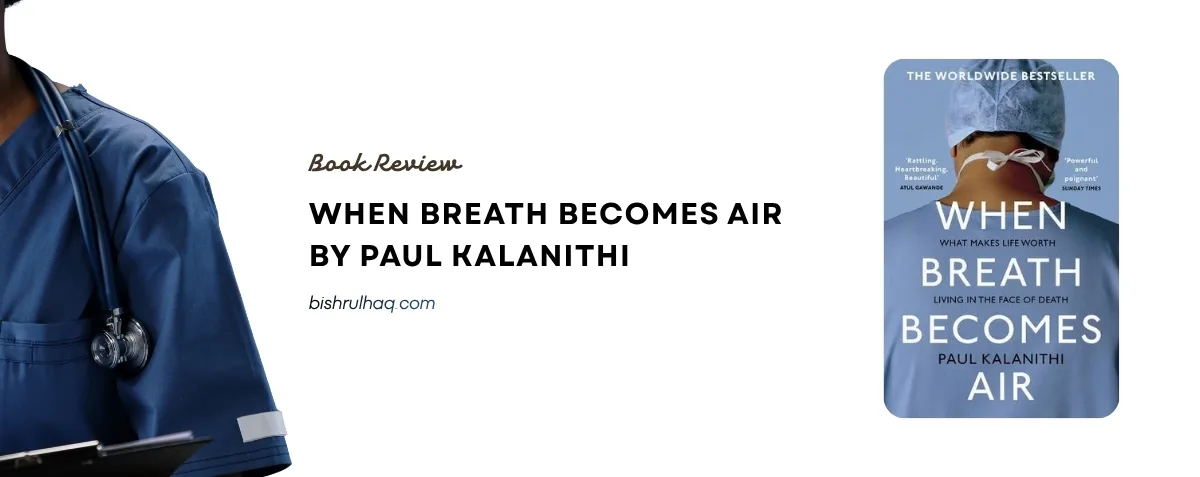
I read this book over a weekend, and I could not really focus on work the Monday after. Not in any dramatic sense. I just sat at my desk for too long staring at the same email thread that suddenly felt very small. When Breath Becomes Air does that to you. Paul Kalanithi was a thirty-six year old neurosurgeon, a year away from finishing his residency, when he was diagnosed with stage IV lung cancer. He spent the time he had left writing this book. He did not finish it before he died. His wife Lucy completed the epilogue. You feel that fact on every page.
What this review covers
- How a literature major became a neurosurgeon, and what that path quietly argues for
- The two halves of the book, and why they add up to something larger than either
- The specific lines I copied into the back of a notebook, with context
- When to read this, when to wait, and who to hand it to first
Warning
A note before you start
This is not a book for every season. If you are in the middle of grief, or have recently lost someone, please be gentle with yourself about when you read it. The book will be there when you are ready. There is no benefit in pushing through it when you do not have the room. Wait. It will still be just as good in six months.
What this book is
It is a memoir in two parts. The first half is about how a literature major drifted into medicine because he could not stop asking what makes a life meaningful. He read his way through philosophy, English, and history in college, kept hitting a wall, and decided that the only way to seriously study what makes life worth living was to be in the room with people who were losing theirs. He became a neurosurgeon. The second half is about being on the other side of that conversation, as the patient.
Paul writes with the precision of a surgeon and the cadence of someone who has read a great deal of poetry. The combination is unusual. Most medical memoirs lean clinical. Most literary memoirs lean indulgent. This one balances on a wire between both, and somehow it never slips.
The lines I will not forget
You can't ever reach perfection, but you can believe in an asymptote toward which you are ceaselessly striving.
That sentence, written by a neurosurgeon about the act of operating, says something I do not think any productivity book has managed to say cleanly. You are never going to be the version of yourself you imagine. You can keep moving toward it. The movement is the practice. The destination is not the point. I copied this line into the back of the notebook I keep at my desk.
Human knowledge is never contained in one person. It grows from the relationships we create between each other and the world, and still it is never complete.
This one sat with me for a long time. I am used to thinking of knowledge as something you accumulate inside your head, like a private collection. Paul reframes it, gently, as something that lives between people. The team. The mentor. The patient. The dying.
What I took from the medical chapters
The middle of the book is about training as a neurosurgeon. It is brutal in a way I did not expect. He works hundreds of hours a week. He watches people die under his hands. He learns the strange professional skill of giving terrible news to families and then driving home and eating dinner. He is honest about the cost of all of this. His relationship strains. He almost loses his marriage. He is clear-eyed about what the work was doing to him before the diagnosis.
What I will keep is his frame on what it means to be good at a hard job. He says, more than once, that being a good doctor is not about technical skill. It is about making sure the patient's humanity is intact when you are done. Take the same idea into any other line of work and it changes things. Being good at what you do is not about polish or output. It is about making sure that the people on the other side of your work are slightly more capable, not slightly more frustrated, when you are finished with them. That is a lower-volume goal than most career advice aims for. I think it might be more accurate.
The diagnosis
The shift, when it comes, is quiet. He starts having back pain. Then weight loss. Then a scan. The book does not slow down to milk the moment. He simply walks you through it, the way he might describe a clinical case, until you realise about two pages in that the case is him.
What he does in the rest of the book is what most of us would not have the strength to do. He sits with the question of how to spend the time he has, given that he does not know whether it is months, years, or a decade. He goes back to operating for a while. He and his wife have a daughter. He starts writing. He is honest that none of these decisions feel clean. They are made in fog, and he is generous enough to leave the fog visible to the reader.
Where my reading hit hardest
- The chapter where he and Lucy decide to have a child despite the diagnosis. There is no neat moral. They simply choose, and the book honours the weight of the choice without reducing it to a lesson.
- The passage where he picks up surgery again and is shocked by how much skill the disease has taken from his hands.
- The epilogue, written by Lucy after his death. I do not have words for that section. I read it twice.
Who should read it
- Anyone in a high-pressure career who has been telling themselves they will think about meaning later.
- Readers of The Midnight Library who want the same questions explored in a non-fictional voice.
- People who like Atul Gawande's Being Mortal. Same lineage, more personal.
Final thought
I gave it five stars without hesitating. Not because every page is brilliant, although a lot of them are. Because the book is honest, and short, and refuses to flatter the reader. Paul could have written a sentimental memoir. He wrote a book that asks you, gently and without lecturing, what you are going to do about your own time. I closed it and felt a little less brave than I want to be, and a little more determined to be braver. That is more than most books in any genre manage.


Comments
0No comments yet. Be the first to share your thoughts.