
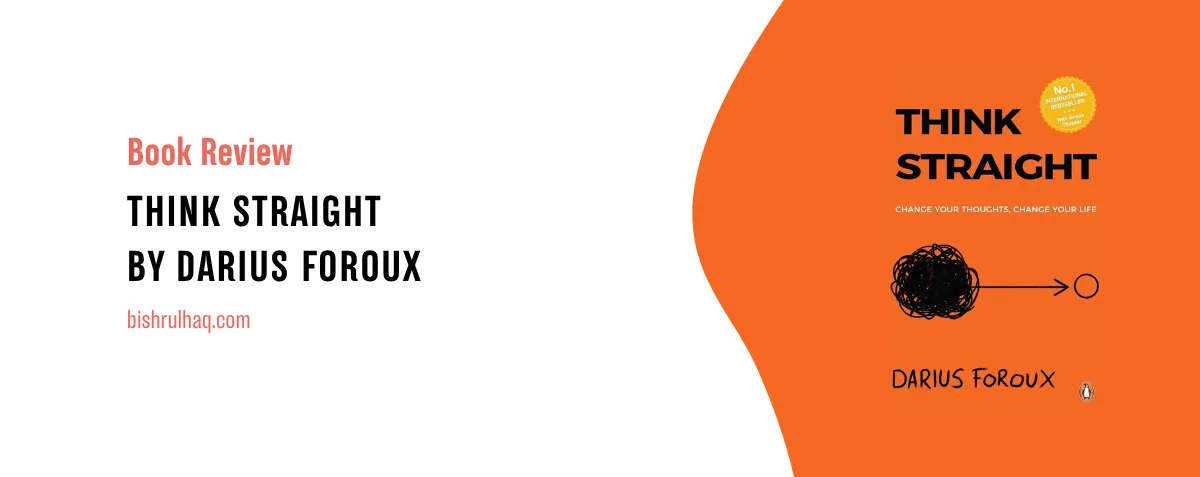
Darius Foroux's Think Straight is the kind of book you finish on a train ride and then spend the next week quietly applying without telling anyone. It is small. It is plainly written. It is not going to dazzle you with new vocabulary or clever arguments. What it will do, if you let it, is make you slightly more honest about how much of your own thinking is actually useful.
The core claim
Foroux's argument, condensed to one sentence, is that most of your thoughts are not helping you. They feel like thinking, but they are closer to static. You rehearse arguments you are never going to have. You catastrophise meetings that will turn out fine. You imagine what someone is going to say about an email you have not yet sent. None of this is serving you, and the first job of clear thinking, according to Foroux, is noticing how much of your mental energy is going into thought that produces nothing.
He is not the first person to make this point. Any competent therapist would make a version of it. Any cognitive behavioural handbook would cover the same ground with more rigour. What Foroux does that most self-help authors do not is strip the idea down to its plainest form and refuse to dress it up. The book reads like a long, earnest conversation with someone who has recently realised something, rather than a lecture from someone who wants to sound wise.
Why most thinking is not really thinking
Foroux draws a line between two very different mental activities and spends a good chunk of the book pointing out which one we usually do. Thinking, in his terms, is when you take an input, reason about it, and produce something you can act on or decide with. Rumination is when you chew on the same material without moving anywhere. It looks like thinking from the inside. It produces none of the outputs.
Once you have this distinction in your head, you start to notice how much of your day is rumination wearing a thinker's clothes. The hour you spent in the shower replaying a disagreement. The walk you took while rehearsing a speech you will never give. The twenty minutes before sleep spent imagining the worst version of tomorrow's meeting. Foroux would say none of that was thinking. It was your brain keeping itself busy while producing exactly zero useful decisions.
What I actually used from it
A handful of ideas in the book are worth keeping.
- The distinction between useful thought and noise. If a thought is not going to change your behaviour, it is not thinking. It is rumination dressed up as analysis.
- The test question, "what am I trying to do here?" Foroux suggests asking this mid-thought when you notice yourself spiralling. It quietly collapses about half the spirals on contact.
- The practice of writing your thoughts down on paper. Something about putting them outside your head makes them much easier to assess honestly.
- The idea that you are allowed to drop a thought without resolving it. Most bad thinking happens because you feel obligated to keep analysing something your brain latched onto for no good reason.
The notebook experiment
I started carrying a small notebook for a couple of weeks after reading this and scribbling down whatever I was chewing on. Roughly eighty percent of what I wrote looked embarrassing the moment it was on the page. A long internal argument with someone I was not going to speak to for another month. A replayed conversation from years ago. A worry about something completely outside my control. That is the whole point. A lot of thoughts survive only because they have not been exposed to daylight. Once they are on a page, in your own handwriting, a lot of them simply evaporate.
The exercise also taught me something Foroux does not explicitly say. The thoughts that survive the page are the ones worth thinking about. They are the ones that have something I can actually do, or decide, or clarify. Everything else is mental tourism. Writing it down is the cheapest filter I know for separating the two.
Where the book runs thin
Foroux repeats himself. The book is already short, and there is at least one chapter that rephrases the previous chapter without adding much. You could trim this book by twenty percent and lose nothing essential. He also dips, occasionally, into language that feels borrowed from Stoic philosophy without quite doing justice to the Stoics themselves. If you have read any serious Seneca or Marcus Aurelius, Foroux's versions will feel thin by comparison, and you will probably find yourself wishing he had either gone deeper into the sources or left them alone.
The other weakness is that the book occasionally confuses plainness with simplicity. There is a difference between saying something in clear language and saying something that is clear. A few chapters lean on the first without quite delivering the second, and you finish them with the feeling that you have read three pages to get one paragraph of actual content.
How it compares to the rest of the shelf
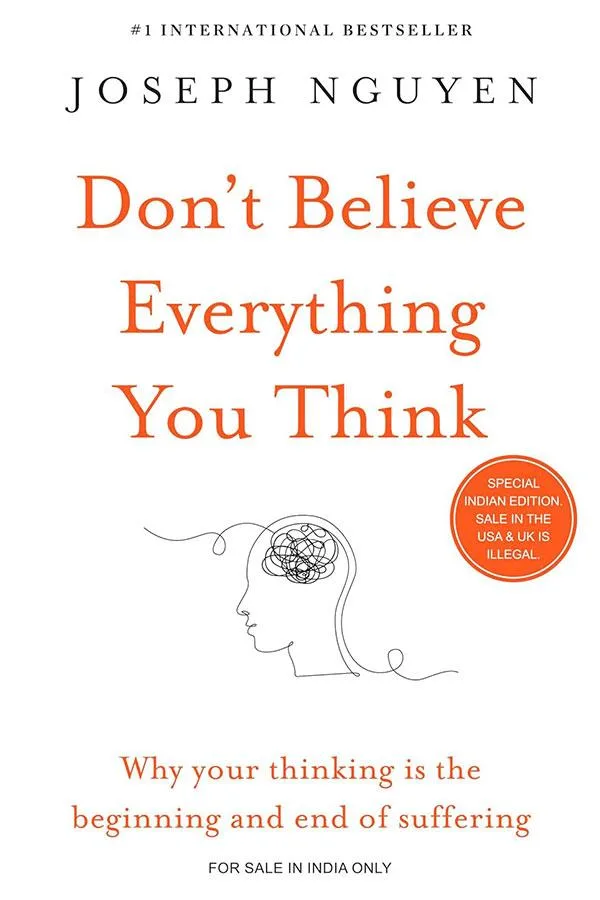
If you have already read books like Don't Believe Everything You Think by Joseph Nguyen, or any of the modern Stoic primers, Think Straight will feel like a simpler version of the same conversation. That is not necessarily a bad thing. Some readers need the simpler version first, and the simpler version does real work. It just means you should not expect depth you are not going to get. Foroux is writing an on-ramp, not a graduate course.
If I had to pick one short book on thinking to hand to a friend who has never thought carefully about thinking, I might actually pick this one over more famous options, purely because it is less intimidating. A book you finish matters more than a book you admire.
Who should read this
- Readers who find most self-help books too long and want something they can finish in one sitting.
- Anyone who has caught themselves running through the same worry for the tenth time and wants a simple nudge to stop.
- People new to the idea of cognitive distance. If you are already deep into therapy or serious meditation, this will feel introductory.
- Managers or parents who need a short, non-threatening book to hand to someone who is stuck in a thought pattern and cannot see it.
It is not the best book on thinking. It is, for a certain kind of reader at a certain moment in their life, a genuinely useful one. That is enough, and I suspect Foroux would agree.


Comments
0No comments yet. Be the first to share your thoughts.