
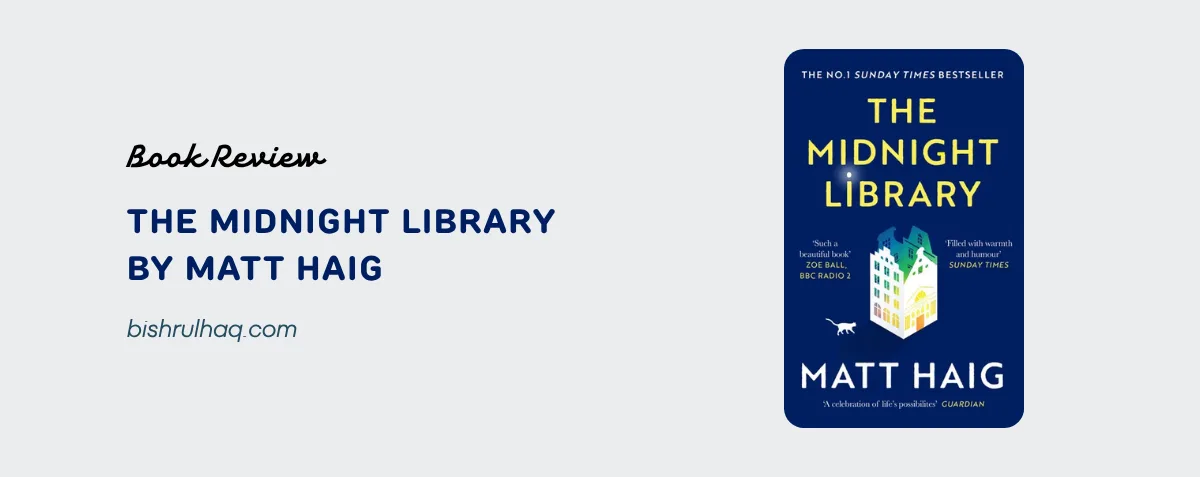
I don't read much fiction. I keep meaning to, and then another technical book arrives in the mail and I tell myself the novel can wait. The Midnight Library was the rare one that pulled me in and didn't let me go back to my pile of non-fiction until I was done with it.
The premise, without spoiling it
Nora Seed has had a bad run. Her cat dies, she loses her job, she feels like she has failed at every major choice in her life. In a moment of despair she finds herself in a strange library that sits between life and death. Every book on every shelf is a version of her life based on a different choice she might have made. Stay with the boy. Take the job. Become the Olympic swimmer. Move to the coast. She can try each life on and see what it would have been.
That is the setup, and it is a lovely hook. What Matt Haig does with it is more interesting than the concept alone.
Why it worked on me
I spent my twenties collecting regrets the way some people collect coffee cups. Jobs I didn't take. Friendships I let drift. The side project I never shipped. Reading this book as a software engineer who constantly wonders what would have happened if I had stayed at a previous role, or moved cities, or gone deeper into a different stack, was uncomfortable in a useful way.
Every life contains many millions of decisions. Some big, some small. But every time one decision is taken over another, the outcomes differ.
The book's quiet, cumulative argument is that there is no perfect life on any of those shelves. Every version of Nora arrives with its own set of problems, its own griefs, its own small disappointments. The regret isn't about the road not taken. It's about believing the road not taken would have been clean.
As a reader, that idea sneaks up on you. You spend half the book hoping Nora finds the perfect life, and then slowly realise Matt Haig is making a different point entirely.
What I liked
- The writing is clean without being thin. Haig doesn't dress up sentences to show off. He lets the ideas carry the weight.
- The chapters are short. Almost dangerously short. I kept telling myself "one more" and then it was 1 a.m.
- Nora is believable. She doesn't turn into a capital-letters Hero. She stays small, confused, and human the whole way through, which is what makes her choices land.
- The book takes mental health seriously without ever becoming a lecture about it. It treats depression the way a friend who has been there would. Quietly. Accurately.
What bothered me slightly
The structure does repeat itself. Nora jumps into a life, explores, hits a limitation, jumps out, returns to the library. By the middle third I could feel the pattern and the tension dipped for me. I also found one or two of the alternate lives a little convenient, where the author's point arrived slightly too quickly to feel earned.
That said, the book is 288 pages. It is allowed to repeat a structure if the structure is working, and for most readers it will. I was clearly trying to find flaws to offset how emotionally affected I was by the ending.
A few lines I wrote down
It is quite a revelation to discover that the place you wanted to escape to is the exact same place you escaped from.
This one I underlined twice. I have moved jobs, moved cities, moved flats, thinking the move itself was the solution. Most of the time I packed my problems into the moving boxes with everything else.
You don't have to understand life. You just have to live it.
There is something about being told this by a fictional character in the middle of an existential crisis that hit harder than any motivational book has managed.
Who I'd recommend it to
- Anyone in the middle of a decision they keep re-opening in their head at 2 a.m.
- Anyone who loved A Man Called Ove or Klara and the Sun. Same emotional register.
- Engineers and other career-builders who keep running hypothetical forks of their own life and wondering which branch was the right merge.
Final thought
I finished The Midnight Library on a quiet Sunday evening. I didn't move for about ten minutes after closing it. I wasn't crying, exactly. I was just sitting with how gently the book had pointed out that the life I'm living, the one I sometimes wish I could edit, is not a draft. It is the thing itself, and I have more power over it than the regrets suggest.
For a short, readable novel that a lot of people will describe as "cosy", it left a deep mark. I'll be handing copies of this one to friends for years.
A small side reflection
One of the strangest effects of reading this book is that it made me kinder to my past self. There is a version of me that made a career decision at twenty-four that I have quietly resented for years. I finished The Midnight Library and realised I had been picturing the alternative version of my life as uniformly better, when Matt Haig's whole point is that the alternative life would have had its own set of quiet disappointments. That imagined self was also going to lose a cat, lose a friend, feel flat on certain Sunday nights, fail at some things and succeed at others. The alternative is not better. It is just different.
That reframing has done a surprising amount of quiet work in the months since. I am less bitter about forks in the road that I cannot re-open. I am more patient with the version of my life I am actually inside. I think that is what good fiction does at its best. It sneaks in a change of perspective that a direct argument could never have made stick.
Highly recommended. Read it on a quiet evening with nothing scheduled for the next morning, in case the last chapter leaves you needing to sit in silence for a while. It did me.
Comments
0No comments yet. Be the first to share your thoughts.