
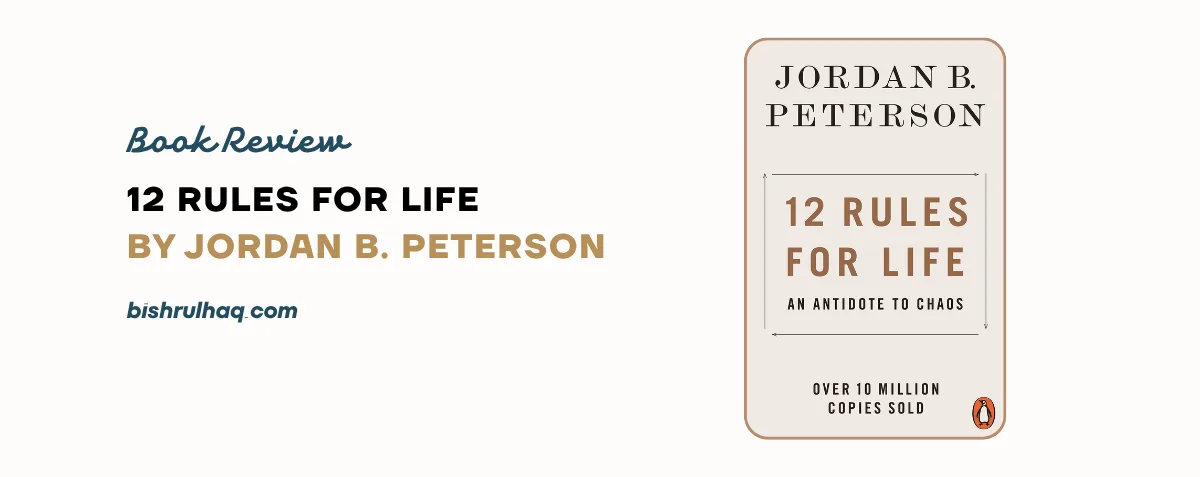
I picked up 12 Rules for Life expecting a tidy self-help checklist. Twelve clean rules, a few anecdotes, a tidy bow. That is not what this book is. It is a sprawling, moody, deeply opinionated book that uses each rule as a doorway into psychology, religion, evolutionary biology, and Peterson's own life. Some chapters I read in one sitting. Others I had to put down for a week and come back to. That tells you what kind of book it is.
The rules that actually stuck
The first rule, "Stand up straight with your shoulders back", sounds almost comically basic until you realise Peterson is using lobster neurochemistry to argue that posture feeds back into your own sense of status and agency. The way you carry yourself is not just a symptom of how you feel. It is also a cause. I started paying attention to how I sit at my desk after reading that chapter, and it genuinely changed how I showed up in meetings that week.
The rule I keep coming back to is "Treat yourself like someone you are responsible for helping." Peterson points out how absurd it is that people will refill a prescription for their dog without missing a dose, but skip their own medication, skip meals, skip sleep, skip the things they know would make them better. I recognised myself in that. I will debug a service for an hour past midnight because I feel responsible to the team, then shrug about missing lunch for the third day.
You deserve some respect. You are important to other people, as much as to yourself. You have a vital role to play in the unfolding destiny of the world. You are, therefore, morally obliged to take care of yourself.
There is something freeing about being told, bluntly, that you have a duty to yourself. Not a right. A duty.
What I took from the middle chapters
The middle of the book is where Peterson goes into his harder territory, about suffering, chaos, and meaning. Rule six is the one that hit me hardest: "Set your house in perfect order before you criticize the world." As a software engineer, I am constantly tempted to fix the team, the codebase, the company, the industry. Peterson's rule is a quiet slap: fix your own things first. My inbox, my posture, my sleep, my small promises I keep breaking to myself. Only then am I allowed to have opinions about bigger things.
A few takeaways I wrote down while reading:
- Compare yourself to who you were yesterday, not to who someone else is today.
- Assume that the person you are listening to might know something you don't.
- Be precise in your speech. Vague problems grow. Specific problems can be solved.
- Do not bother children when they are skateboarding. In other words, stop over-protecting people from the productive risk that actually teaches them anything.
That last one is deceptively deep. So much of modern life is about eliminating friction, and Peterson is arguing that a lot of the friction is the thing you actually needed.
Where it tested my patience
I will not pretend the book is flawless. Peterson digresses. He will take you from a rule about lying to a long passage on Cain and Abel to a story about a patient he once treated, and then double back to the original point. If you like clean, punchy, one-takeaway-per-chapter writing, this book is going to annoy you. I found myself skimming two or three sections where I felt the myth analysis had gone past where the argument needed it.
There are also political undertones that depending on who you are will either feel like plain-spoken honesty or like a detour you didn't sign up for. I tried to read the book as charitably as I could. Most of what matters sits underneath the politics: take responsibility, tell the truth, stand up, care for what is yours, aim at something meaningful.
Why I would still recommend it
For all its flaws, 12 Rules for Life is one of the few self-help books I have read that treats the reader like an adult who can handle hard ideas. It does not hand you a morning routine and pretend that solves everything. It asks you to look at your own life honestly and then pick the smallest piece you can actually lift.
A few months after finishing, the ideas that stayed with me are strangely practical. I keep my room tidier. I reply to difficult emails faster because I can hear Peterson in the back of my head asking why I'm lying to myself about putting it off. I take my own health seriously in a way I didn't before.
If you are in a season where things feel slightly off but you can't name what, this book will probably give you the vocabulary for it. It did for me.
Who should read it
- Anyone in their late twenties or thirties who feels stuck but cannot point at why.
- People who liked Man's Search for Meaning and want something longer and denser.
- Anyone who is tired of cheerful, low-calorie self-help.
Skip it if you want something light, or if you have no patience for long tangents about mythology. Read it if you are willing to meet the book where it is and do the work of picking out what serves you.
Final thought
Peterson's underlying bet is that meaning, not happiness, is the thing worth organising your life around. He makes the case that happiness is a byproduct, and a flaky one at that. Meaning is what you get when you take on a voluntary burden that is heavier than you thought you could carry, and carry it anyway. I needed to hear that. Most of the self-help I had absorbed before this book was optimising for ease, and I was genuinely surprised how much better I felt when I swapped that optimisation for something harder.
I still don't agree with everything in the book. I don't think you're supposed to. Peterson is at his best when he is pushing you to look at yourself honestly, and at his worst when he is projecting that honesty outward as a cultural critique. The useful move, I think, is to read him the same way you'd read any older teacher. Take what serves you. Leave the rest. The parts that do serve you will, quietly, keep showing up in how you move through the week after you close the book.
Comments
0No comments yet. Be the first to share your thoughts.