
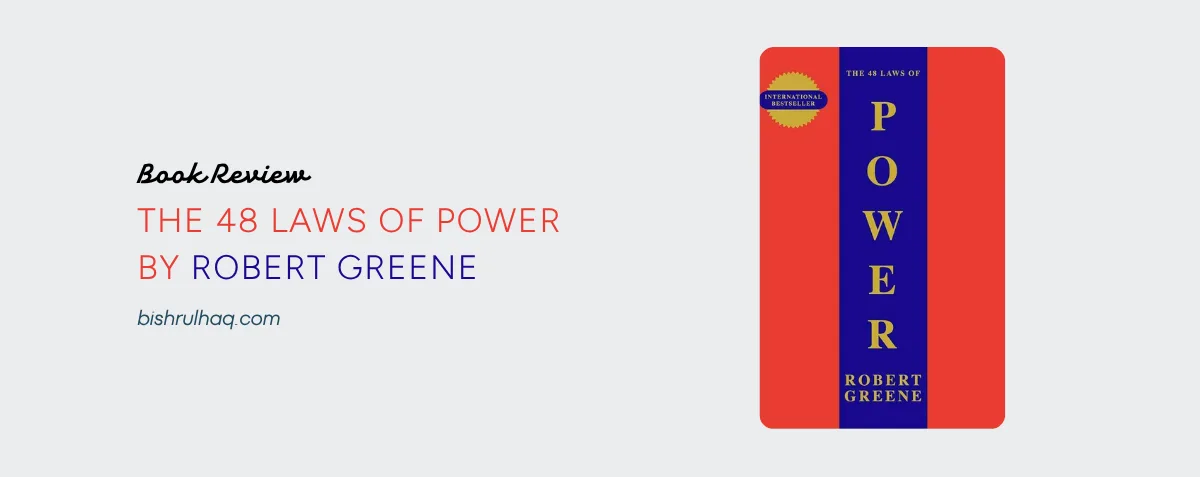
Many things have been said about Robert Greene The 48 Laws of Power: it is a handbook to sociopaths, a survival guide in the workplace, a Machiavellian success manual. Published initially in 1998, it has sold millions of copies and has been referenced by everyone, including hip-hop artists and business executives. But is it really such a dangerous blueprint of manipulation, or of clear-eyed diagnosis of the workings of power? But what is more intriguing is on further reading that it is both and that conflict makes the book inexhaustible.
Greene is able to compress centuries of history, Sun Tzu, Napoleon, the Medici, and his own 48 discrete laws. The laws are provided with a short explanation, historical examples (of people who adhered to the law and those who violated it), as well as keys to power. What has come out is a thick, aphoristic writing that borders on a grimoire. However, at the bottom of the cynicism, there is a painful fact the laws explain the patterns of the behavior that appear to repeat independent of our moral desires.
Form and Style: A Book of Magic in the World.
The book is carefully organized in the form of series of lessons. Every law begins with a bald statement "Never Outshine the Master," "Conceal Your Intentions," "Crush Your Enemy Totally" and then supports it with anecdotes of history. Greene is straight forward, near cold. He does not editorialise much; he merely puts the evidence before us. It is the absence of moral hand-holding that makes the book so disturbing and so effective.
Take Law 1: Do not shine on the Master. Greene narrates the tale of a French finance minister, Nicolas Fouquet who hosted a grand party to impress King Louis XIV. It pleased not the king, he was threatened. Fouquet was indicted and sentenced to life imprisonment. The moral: put those above you make of you feel superior. Greene does not tell us whether it is right or wrong he merely demonstrates that neglect of it brings about disaster. The main mode of the book is that cold pragmatism.
Important Themes: The Money of Human Relation.
Throughout the 48 laws, some motifs can be traced: the ability to move slowly, the risk of expressing your feelings, the strength of the unpredictable, the need to understand when to back off. Greene uses examples of such different figures as the Chinese strategist Sun Tzu, the Italian diplomat Niccolai Machiavelli, and the American mobster John Gotti. The laws have a sense of their universality due to the variety of examples, though they are sometimes overextended.
Among the less obvious things that can be learned is that power is a relational concept. It does not belong to you, it is given to you, by other people, not always intentionally. Law 3: "Conceal Your Intentions" does not mean that you should lie, but that you should make it not clear that you are about to do something so that your moves are not refuted by others. Likewise, Law 9: Win through your actions, never through argument states that actions are more convincing than words a principle that any negotiator is familiar with.
The Dark Side: Ethics and Accountability.
Critics believe that the book promotes amoral and unkind actions. That is true. Greene laws presuppose a zero sum world, in which the profit of one man is the loss of another. He does not talk about win-win situations, collaboration, and trust on basis of transparency very often. Rather, he makes any interaction a possible field of battle. The laws can be toxic taken literally and applied to personal relationships. An intimate partner who will always hide his or her intentions will ruin intimacy. The kind of manager who destroys enemies wholesale will create resentment and turnover.
But Greene himself does not insist on applying all the laws to all situations. During interviews, he has indicated that the book is descriptive, not prescriptive a kind of an art of war, to social climb. It presupposes that you are already in a competitive field (politics, business, law, entertainment) the rules of which are already cruel. Knowing those rules, you have three options: obey, evade, or evade.
Why It Endures: A Reflexion, not a Manual.
The book is long-lasting because it is not afraid to make the quiet loud. Majority of the people understand that flattery thrives, that displaying weakness can be used to their advantage, that it is usually wise to keep their mouths shut. Greene simply codifies it. The 48 Laws of Power presents some form of gritty realism in the world where numerous self-help books have imprecise optimism. Not because you should obey all the laws but because you can know when other people are applying them to you.
I admire the breadth of research: Greene draws examples of all time and all culture, one after the other, the historian in me. The brutal clarity is valued by the writer in me. But the human part of me cries out to be cautious. It is a book to be read with your eyes open, not as a recipe but as a lists of what you will find people doing when they quit pretending.
Power is a game. And like any game, to be good at it you must be familiar with the game rules- whether they are written or not.
The spirit of the book is the spirit of that line, which I paraphrase of the philosophy of Greene. It is not an evil guide; it is a field-guide to a type of reality. Playing the game or not, knowing the moves is strength itself.
Concluding remarks: An Indispensable Book
The 48 Laws of Power is not an easy read. It questions the courteous lies we all know about merit, justice, and human decency. Yet, it is a must to anyone who is serious about influence, negotiation or the more sinister aspects of office politics. Critically read it, debate it but do not reject it. The laws might be ancient, but the heart of man had not altered much.
Eventually, Greene makes us remember that power is neither good nor evil, but it is. It is up to you to use it or not.






Comments
0No comments yet. Be the first to share your thoughts.