
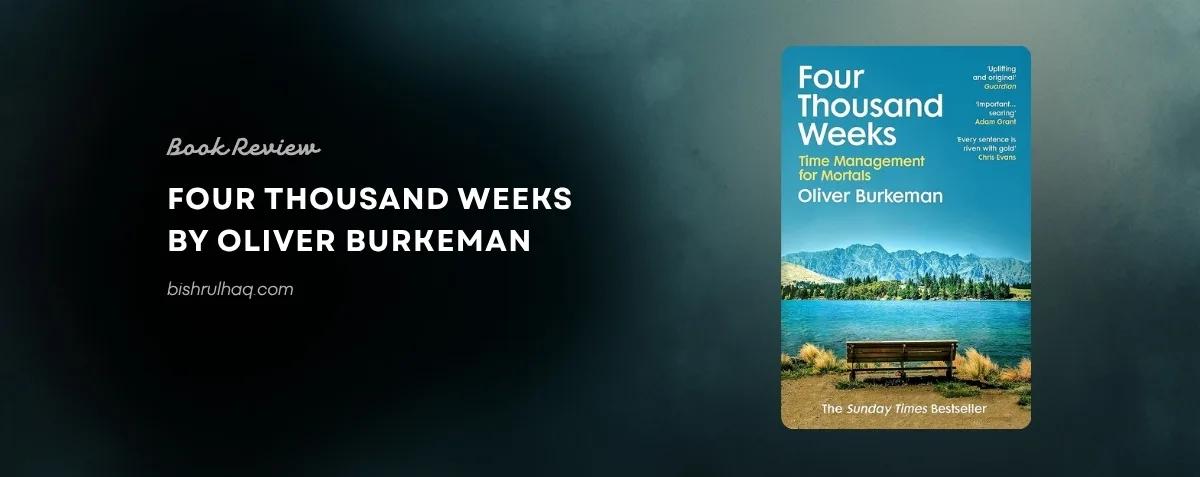
Oliver Burkeman begins where most time-management books refuse to look. You are finite. Your list will outlive you. Your inbox is not a moral test. The fantasy that you can finally get on top of everything is part of what keeps you anxious.
That sounds bleak, but the book is not bleak. It is oddly relieving. I felt the pressure drop once the book stopped pretending time could be conquered and started asking what a person might do after admitting it cannot be.
A time book that refuses the usual promise
Most productivity books promise control. Burkeman starts by taking that promise away. You have roughly four thousand weeks if you live a normal human lifespan, and no system will make that feel like enough. Strangely, that is what makes the book freeing.
The book's title points to the rough number of weeks in an average lifespan. That number is small enough to feel rude. Burkeman uses it not to panic the reader, but to puncture the illusion that better systems will eventually make life feel limitless.
What I liked most is that the book does not sneer at planning. It simply refuses to worship it. Planning is useful. Control is limited. That small distinction changes the mood of the whole book.
Time notes I kept
- The book is less about doing more and more about accepting finitude.
- It challenges the fantasy that perfect organisation will save you.
- Its most useful move is turning limitation into a source of clarity.
What makes it different
The deepest idea here is that limitation can create clarity. If you cannot do everything, then choosing is not a failure. It is the basic human condition. That turns prioritising from a productivity tactic into a form of honesty.
Burkeman is especially good on the way efficiency can make life worse. The faster you clear tasks, the more tasks appear. Speed does not always create peace. Sometimes it simply raises the expected speed of everything around you.
I also liked the book's suspicion of perfect readiness. Many people delay real life until the work is under control, the plan is stable, or the timing is clean. The book keeps asking what you are postponing while waiting for a kind of control that may never arrive.
What changed about time while reading
The book made me notice how often I treat time like a storage problem. If I can arrange the tasks better, stack them better, automate them better, maybe everything will fit. Burkeman's challenge is that life is not a suitcase. Some things will not fit, and that is not a personal failure.
That point changes the emotional tone of planning. A normal to-do list can carry hidden shame, as if every unfinished item is evidence against your character. The book says no. Unfinishedness is built into the condition. The task is not to escape it, but to choose your unfinishedness more honestly.
I also liked the book's resistance to turning every hour into future value. Productivity culture often treats the present as raw material for a better later. Burkeman keeps asking whether later is becoming an excuse to never arrive anywhere.
The uncomfortable truth is that many meaningful things are inefficient. Friendship is inefficient. Art can be inefficient. Prayer, play, walking, and caring for people are often inefficient. That does not make them wasteful. It may be exactly why they still feel human.
Reading the book did not make me abandon planning. It made me plan with less fantasy. I still want lists, calendars, and routines. I just trust them less as salvation. They are tools for a finite life, not a way to become infinite.
The relief inside the limit
The relief of this book is that it removes the impossible assignment of becoming a person who can do everything. Once that assignment is gone, a day can become more honest. You still have work to do, but you do not have to pretend the right system will make you unlimited.
I would keep this book close during seasons of overcommitment. It helps you ask which disappointment you are choosing. Since some disappointment is unavoidable, the mature move is to choose the one that protects the life you actually want.
Who should read this slowly
This is best for the person who has tried apps, notebooks, routines, and productivity systems but still feels late to their own life. It will not give you a shiny dashboard. It will question why you wanted one so badly.
It is also good for readers who enjoy philosophy when it stays close to daily life. The book talks about mortality, but it also talks about email, distraction, ambition, patience, and the strange guilt of being unable to do everything.
What works and what does not
✓ What works
- Deeply humane and unusually honest about time
- Pushes back against productivity culture without becoming lazy
- Leaves you with better questions, not just better tactics
✕ Where it falls short
- Readers wanting a simple system may feel underfed
- Some chapters are philosophical rather than practical
- The message can feel uncomfortable if you are used to optimisation
What might frustrate readers
Some readers will want more tactics. That is understandable. The book is not a step-by-step system, and anyone looking for a morning routine may feel underfed.
The other challenge is emotional. Accepting finitude sounds wise in theory, but it can feel irritating when you are overloaded. The book does not remove that tension. It asks you to stop lying about it.
How to live with the idea
I would use this book by choosing one project to disappoint on purpose. Not neglect irresponsibly, but admit that it is not the main thing right now. That kind of chosen disappointment is part of adulthood.
I would also make room for activities that do not scale: a walk, a long conversation, reading without measuring progress, cooking slowly, sitting without turning the moment into content. The book makes those things feel less like inefficiency and more like life.
The useful discomfort
This is the book I would give to someone who has tried every app, planner, and routine and still feels behind. The problem may not be the system. The problem may be the belief that life can be finished.
The discomfort is the gift. Four Thousand Weeks does not make time feel abundant. It makes the scarcity feel honest enough to guide you.


Comments
0No comments yet. Be the first to share your thoughts.